
SlideServe
Menu
Préférences
© SlideServe · v2026

By: Madison and Camille

trynt avatar
8 diapositives · 297 Views · Jan 08, 2014

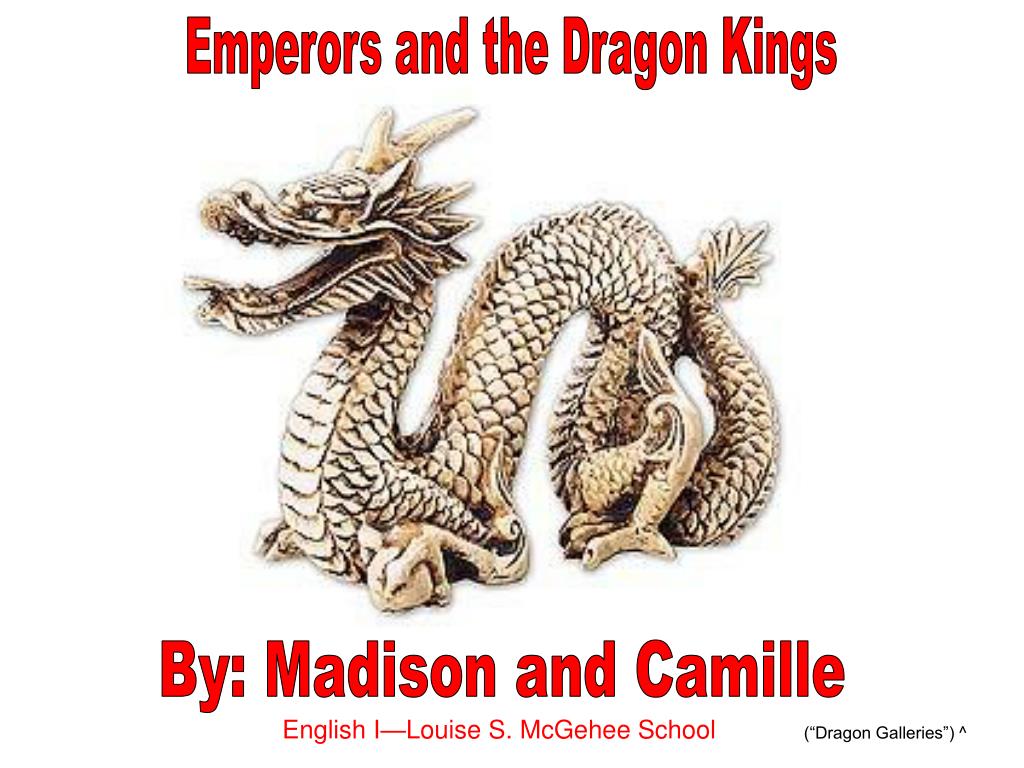
Emperors and the Dragon Kings. By: Madison and Camille . English I—Louise S. McGehee School. (“Dragon Galleries”) ^. The Dragons . Chinese call themselves “Lung Tik Chuan Ren,” or Descendants of the Dragon.
By: Madison and Camille - slide 1
01 / 8By: Madison and Camille
1 / 17

Télécharger la présentation

By: Madison and Camille
Une image / un lien ci-dessous est fourni (tel quel) pour télécharger la présentation

Politique de téléchargement : le contenu du site vous est fourni TEL QUEL pour votre information et votre usage personnel ; il ne peut être vendu, concédé sous licence ni partagé sur d’autres sites sans l’accord de son auteur.Le contenu vous est fourni TEL QUEL, pour votre information et votre usage personnel uniquement. Téléchargez la présentation en cliquant sur ce lien. Lors du téléchargement, si vous ne parvenez pas à télécharger une présentation, l’éditeur a peut-être supprimé le fichier de son serveur.Pendant le téléchargement, si vous ne parvenez pas à obtenir une présentation, le fichier a peut-être été supprimé par l’éditeur.

F I N

Plus de contenu associé

Transcription de la présentation
  1. Emperors and the Dragon Kings By: Madison and Camille English I—Louise S. McGehee School (“Dragon Galleries”) ^

  2. The Dragons • Chinese call themselves “Lung Tik Chuan Ren,” or Descendants of the Dragon. • During the year of Dragon (which is every twelve years), people receive “health, wealth, and a long life” (Yaoting, Chen). • The Imperial Dragon is the symbol for powerful rulers. • Imperial dragons supposedly brought great wealth. • Lung (another word for the Chinese dragon) represents power to the sovereign. ^Chinese symbol of a dragon^ (“All About Feng Shui”)

  3. Emperors • “Dragons are so wise that they have been royal advisors” (GuoXin, Zhou). • Many of the dragon’s descendants became great rulers. • Emperors of China depended on dragons’ fortunes to become successful rulers. • Many emperors believed that without the dragon, they would not be able to rule as successfully as they could. (Davis, Hadland) ^ (“Animation Library”) >

  4. ж   If you called an emperor of China a dragon face, they would take it as if you were complimenting them. ж     During the different dynasties, the emperors would offer sacrifices to the dragon kings – to receive good fortunes. (“The Chinese Dragon”) ^ (“Animation Library”) ^

  5. Dragon Kings • In ancient Chinese mythology, the dragon represents one of the four spirits. • Different dragons correspond to directions, different seas, and things in Heaven and Earth. (“The Chinese Dragon”) ^

  6. Myths (“Dragon Galleries”) • The Chinese word for myth is shen hua, which means stories of gods. Chinese myths do not only come from China, but they can start in other places.  • In Chinese mythology, there are the Dragon Kings of the Five different emperors. They all have certain purposes in these myths. They consist of dragons that guard, control wind and rain, first dragon, and the heavenly and earthly dragons. (“Animation Library”) >

  7. Works Cited “All About Feng Shui.” Feng Shui Products Cures and feng shui tips On-line – All About Feng Shui Store. 2003/2004. Feng Shui International. 3 January 2005. <http://www.all-about-feng-shui.co.uk/symbols/chinese-horoscope- symbols.html>. “Animation Library.” Animation Library: Thousands of FREE Animations. Ed. John Hilton. 2000-2005. Animation Library. 5 January 2005. <http://www.animationlibrary.com/a-l/?n=image.php3&image_id=1773>. “The Chinese Dragon.” The University of York. Eds. English as a Foreign Language Unit. 4 January 2005. <http://www.york.ac.uk/inst/ltc/efl/courses/ALD/Wang/dragon1.htm>. Davis, Hadland. “Onmark Productions.com and Above Average Production.” Onmark Productions Web Designs & Buddhist Shinto Photo Dictionary of Japanese Deities. Ed. Mark Schumacher. 1995 to 2005. Bilingual Web Creations. 4 January 2005. <http://www.onmarkproductions.com/html/dragon.shtml>.

  8. Works Cited Continued “Dragon Galleries.” Dragon Galleries – Oriental Paintings, Sumi-e, Chinese, Japanese Painting, Calligraphy, Art Gal. Silver Dragon Studio. 4 January 2005. <http://www.dragongalleries.com/Dragons.html>. GuoXin, Zhou. “Crystal Dragon of Taiwan.” Dragon Articles. Ed. Designs 3. Last Revised: 01/06/2005. Crystal Dragon of Taiwan (CDOT). 3 January 2005. <http://www.cdot.org/history/dragon_articles.htm>. Yaoting, Chen. “The Dragon King.” Daoist Beliefs Immortals and Immortalism. Ed. David Palmer. 6 January 2005. <http://www.eng.taoism.org.hk/daoist- beliefs/immortals&immortalism/pg2-4-4-5.asp>.