Random Variable (RV)
This article provides a comprehensive overview of random variables (RVs), explaining their definition as functions assigning numerical values to experimental outcomes. We discuss discrete and continuous RVs, including Probability Mass Functions (PMF) for discrete RVs and Probability Density Functions (PDF) for continuous RVs. Various examples illustrate how to calculate expectations, variances, and standard deviations, along with practical applications like lottery expectations and insurance policies. This foundational knowledge is essential for studies in probability and statistics.

Random Variable (RV)
E N D
Presentation Transcript
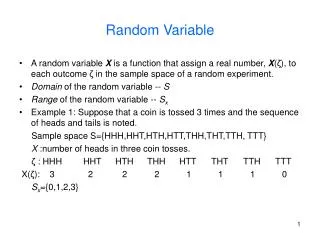
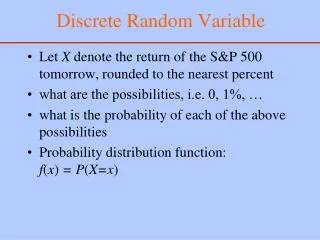
Random Variable (RV) A function that assigns a numerical value to each outcome of an experiment. Notation: X, Y, Z, etc Observed values: x, y, z, etc
Example 1 Two fair coins tossed. Let X = No of Heads OutcomesProbability Value of X HH ¼ 2 HT ¼ 1 TH ¼ 1 TT ¼ 0
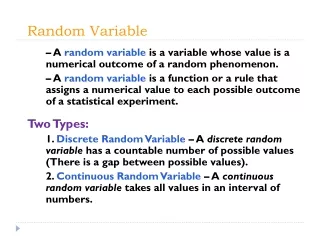
Random Variable • Discrete RV – finite or countable number of values • Continuous RV – taking values in an interval
Probability Distribution • Probability distribution of a discrete RV described by what is known as a Probability Mass Function (PMF). • Probability distribution of a continuous RV described by what is known as a Probability Density Function (PDF).
Probability Mass Function (PMF) p(x) = Pr (X = x) satisfying • p(x) ≥ 0 for all x • ∑p(x) = 1
Example 1 (Contd) X = No of Heads. The PMF of X is: xPr (X = x) 0 1/4 1 2/4=1/2 2 1/4
Probability Density Function (PDF) f(x) satisfying • f(x) ≥ 0 for all x • ∫f(x) dx = 1 • ∫ab f(x) dx = Pr (a < X < b) • Pr (X = a) = 0
Expectation E (X) = ∑x p (x) for a Discrete RV E (X) = ∫x f (x) dx for a Continuous RV
Expectation E (X2)= ∑x2 p (x) for a Discrete RV E (X2) = ∫x2 f (x) dx for a Continuous RV
Expectation E (g(X)) = ∑g(x) p (x) for a Discrete RV E (g(X)) = ∫g(x) f (x) dx for a Continuous RV
Variance Var (X) = E (X2) – (E(X))2
Standard Deviation SD (X) = √Var (X)
Properties of Expectation E (c) = c for a constant c E (c X) = c E (X) for a constant c E (c X + d) = c E (X) + d for constants c & d
Properties of Variance Var (c) = 0 for a constant c Var (c X) = c2 Var (X) for a constant c Var (c X + d) = c2 Var (X) for constants c & d
Example 1 (Contd) X = No of Heads. Find the following: (a) E (X) Ans: 1 (b) E (X2) Ans: 1.5 (c) E ((X+10)2) Ans: 121.5 (d) E (2X) Ans: 2.25 (e) Var (X) Ans: 0.5 (f) SD (X) Ans: 1/√2
Example 4 If X is a random variable with the probability density function f (x) = 2 (1 - x) for 0 < x < 1 find the following: (a) E (X) Ans: 1/3 (b) E (X2) Ans: 1/6 (c) E ((X+10)2) Ans: 106.8333 (d) Var (X) Ans: 1/18 (e) SD (X) Ans: 1/(3√2)
Example 5 An urn contains 4 balls numbered 1, 2, 3 & 4. Let X denote the number that occurs if one ball is drawn at random from the urn. What is the PMF of X?
Example 5 (Contd) Two balls are drawn from the urn without replacement. Let X be the sum of the two numbers that occur. Derive the PMF of X.
Example 6 The church lottery is going to give away a £3,000 car and 10,000 tickets at £1 a piece. (a) If you buy 1 ticket, what is your expected gain. (Ans: -0.7) (b) What is your expected gain if you buy 100 tickets? (Ans: -70) (c) Compute the variance of your gain in these two instances. (Ans: 899.91 & 89100)
Example 7 A box contains 20 items, 4 of them are defective. Two items are chosen without replacement. Let X = No of defective items chosen. Find the PMF of X.
Example 8 You throw two fair dice, one green and one red. Find the PMF of X if X is defined as: • Sum of the two numbers • Difference of the two numbers • Minimum of the two numbers • Maximum of the two numbers
Example 9 If X has the PMF p (x) = ¼ for x = 2, 4, 8, 16 compute the following: (a) E (X) Ans: 7.5 (b) E (X2) Ans: 85 (c) E (1/X) Ans: 15/64 (d) E (2X/2) Ans: 139/2 (e) Var (X) Ans: 115/4 (f) SD (X) Ans: √115/2
Example 10 If X is a random variable with the probability density function f (x) = 10 exp (-10 x) for x > 0 find the following: (a) E (X) Ans: 0.1 (b) E (X2) Ans: 0.02 (c) E ((X+10)2) Ans: 102.02 (d) Var (X) Ans: 0.01 (e) SD (X) Ans: 0.1
Example 11 If X is a random variable with the probability density function f (x) = (1/√(2)) exp (-0.5 x2) for - < x < find the following: (a) E (X) Ans: 0 (b) E (X2) Ans: 1 (c) E ((X+10)2) Ans: 101 (d) Var (X) Ans: 1 (e) SD (X) Ans: 1
Example 12 A game is played where a person pays to roll two fair six-sided dice. If exactly one six is shown uppermost, the player wins £5. If exactly 2 sixes are shown uppermost, then the player wins £20. How much should be charged to play this game is the player is to break-even?
Example 13 Mr. Smith buys a £4000 insurance policy on his son’s violin. The premium is £50 per year. If the probability that the violin will need to be replaced is 0.8%, what is the insurance company’s gain (if any) on this policy?