Understanding Brushing: Human Adaptation versus Robotic Precision in Oral Care
This study explores the intricacies of teeth brushing as viewed through the lenses of both human adaptation and robotic precision. While humans possess an inherent sense of direction, allowing for improvisation and adaptive brushing techniques, robotic models operate on predefined algorithms that limit their ability to adjust dynamically. Key differences in learning processes are highlighted, showing that humans learn through practice and imitation, while robots follow strict step-by-step instructions. The effectiveness of different brushing techniques underscores the ongoing debate between flexibility and rigidity in dental care methods.

Understanding Brushing: Human Adaptation versus Robotic Precision in Oral Care
E N D
Presentation Transcript
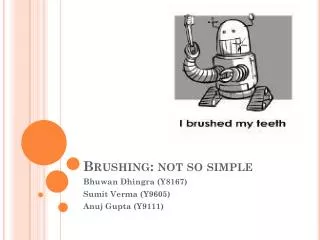
Brushing: not so simple BhuwanDhingra (Y8167) SumitVerma (Y9605) Anuj Gupta (Y9111)
Space Representation • Humans have an inherent sense of direction and location • Robotic models rely on a predefined set of axes, and precise instructions on them • Both have their advantages
Improvisation • Adaptation • Broken tooth, Ulcers etc. • Others teeth!!!!! • Different brush • Different pressure on different teeth • Do we have a rigid algorithm??? • Robots follow a predefined algorithm
LEARNING • Humans learn with practice • Difference in learning • Babies by imitation • Robots by step by step instruction • Once the values are fed, robots can’t make much changes