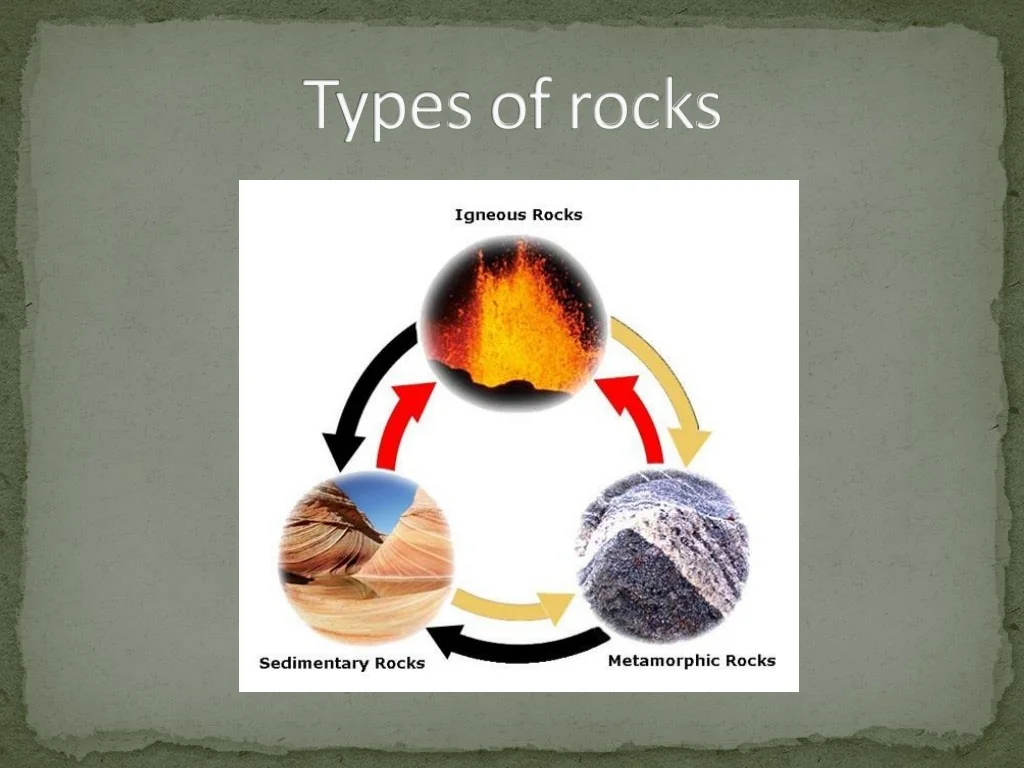
Types of rocks
3 types of rocks: • There are 3 types of rocks found on Earth: • Igneous • Sedimentary • Metamorphic
Igneous Rocks - Formation • Igneous Rocks are formed by melting, cooling, and crystallization of other rocks. • Igneous rocks form as a result of volcanic activity, hot spots, and melting that occurs in the mantle.
Igneous rocks • Igneous rocks are common along plate boundaries or mantle hot spots
Igneous Rocks - Classification • Igneous rocks are classified using their texture in the following ways: • Glassy • Aphanitic (no visible crystals) • Phaneritic (visible crystals) • Porphyritic (Some visible and some not visible crystals)
Igneous Rocks - Texture • Crystal size is used to classify igneous rocks. • Crystals form as the rock cools, and the crystal size can tell us a lot about its cooling history: • The larger the crystals, the slower it cooled.
Igneous Rocks - Texture • Glassy igneous rocks have no crystal structure, and probably formed by very rapid cooling (such as on the surface of a lava, or when a lava enters the water.)
Igneous Rocks - Texture • Aphanitic rocks have no visible crystals, and probably formed by fast cooling above ground.
Igneous Rocks - Texture • Phaneritic rocks have visible crystals, and probably formed by slow cooling below ground.
Igneous Rocks - Texture • Porphyritic rocks have both visible and nonvisible crystals, and probably formed by two different cooling events.
Igneous Rocks - Classification • Dark igneous rocks are formed from basaltic or mafic magma. (Mafic because it contains a lot of magnesium and iron). • The magma that forms these rocks is usually very hot (around 1000°C) and viscous (about the same viscosity as ketchup.)
Igneous Rocks - Classification • Light colored igneous rocks are formed from silicic (high silica content) or felsic magmas. • The magmas that form these rocks is usually more cool, (lower than 850°C), and more viscous (about the viscosity of peanut butter.)
Igneous rocks - Formations • Structures and formations seen in igneous rocks include: • Hexagonal columnar joints • Pahoehoe lava flows • Dikes, sills, and batholiths (plutons) • Pillow basalts • Volcanoes
Igneous Rocks - Examples • The most common types of igneous rocks include: • Rhyolite • Andesite • Basalt • Granite • Diorite • Gabbro
Igneous rocks charted
Sedimentary Rocks - Formation • Sedimentary rocks are formed by weathering, erosion, deposition, compaction, and cementation of other rocks. • Sedimentary rocks form in areas where water, wind, or gravity deposit sediments.
Sedimentary rocks - formation • Sedimentary rocks are likely to form in areas such as: • Deltas • Beaches • Rivers • Glaciers • Sand dunes • Shallow seas • Deep oceans
Sedimentary rocks - Classification • Sedimentary rocks are classified into two groups: • Clastic rocks • Chemically formed rocks
Sedimentary rocks – Classification • Sedimentary rocks are Clastic if they are made of pieces of other rocks that have been weathered and eroded. • Clastic rocks are grouped based on the size of grain that they are made from.
Sedimentary rocks - Classification • Very small particles make up mudrock. • Medium sized particles make up sandstone. • Large particles make up conglomerates.
Sedimentary rocks - Classification • Sedimentary rocks that form from chemical processes are called biochemical rocks (formed from living things) or Chemical precipitates (formed from lakes or shallow seas.)
Sedimentary rocks - formations • Structures and formations seen in sedimentary rocks include: • Stratification • Cross bedding • Graded bedding • Ripple marks • Mud cracks • Fossils
Sedimentary rocks - Examples • Conglomerate • Sandstone • Shale • Limestone • Gypsum • Oolites • Chert (including black flint and red jasper)
Metamorphic rocks - Formation • Metamorphic rocks are formed by heat and pressure changing one type of rock into another type of rock. • Metamorphic rocks form near lava intrusions, at plate subduction zones, and in deep mountain roots.
Metamorphic rocks - Formation • Lava intrusions can provide heat that causes metamorphic rocks to form. These small areas of metamorphic rock form from contact metamorphosis.
Metamorphic rocks - Formation • Rocks that metamorphose because of increasing heat and pressure found at plate subduction zones and in deep mountain roots form large areas of metamorphic rock through regional metamorphosis.
Metamorphic rocks - Classification • Metamorphic rocks are classified into 2 major groups: • Foliated • Nonfoliated
Metamorphic rocks - Classification • Foliated rocks form when differential pressure causes minerals to form in layers. • These rocks will have stripes or planes that they will break easily along. • These “stripes” don’t usually line up with the original bedding planes in sedimentary rocks.
Metamorphic rocks • Nonfoliated metamorphic rocks formed in areas where the pressure from all sides was equal, so there is no “linear” quality to the rocks.
Metamorphic rocks - Formations • Structures and formations seen in metamorphic rocks include: • Folding • Plastic deformation • Stretching • Alternating dark and light layers (gneissic foliation)
Metamorphic rocks - Examples • Some common types of metamorphic rock include: • Slate • Schist • Gneiss • Amphibolite • Marble • Quartzite • Metaconglomerate
Metamorphic rocks - Charted