Architecting Climate Resilience: Navigating Globalization and Sustainability Challenges
The International Union of Architects hosted a vital discussion at the Tavasi Epiteszeti Festival in Budapest on March 5, 2010, addressing the critical interplay between global challenges of climate change and the necessity for sustainable development. Topics covered include awareness of economic implications, strategies for managing environmental crises, and innovative design solutions. Critical perspectives were outlined, focusing on urbanization trends, social inequalities, and the urgent need for collaborative actions across nations to ensure a sustainable and resilient future for our cities.

Architecting Climate Resilience: Navigating Globalization and Sustainability Challenges
E N D
Presentation Transcript
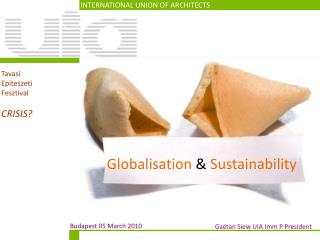
INTERNATIONAL UNION OF ARCHITECTS Tavasi Epiteszeti Fesztival CRISIS? Globalisation & Sustainability Budapest 05 March 2010 Gaëtan Siew UIA Imm P President
INTERNATIONAL UNION OF ARCHITECTS The World : Three attitudes Why ? • Why? • Awareness • Economic reasons • Survival Sustainable development?
INTERNATIONAL UNION OF ARCHITECTS The World : Three attitudes Awareness 5,7°C Impossible 4°C Divergence 3°C Status quo. Too ambitous 2°C Could be better. 1°C Possible Copenhagen, Denmark 300 000 people COP 15
INTERNATIONAL UNION OF ARCHITECTS The World : Three attitudes Economic reasons • KYOTO • Right to emit • Joint implementation • Clean development mechanism • 1 Hectare of coral reef • = • 80 000 to 1 million US$/year revenue • in leisure and tourism • = • 25 000 to 34 000 US$ for protection Bonaire, Netherland Antilles • N Stern report • It’s not too late • Climate change has serious impacts over growth & development • Stabilising costs are manageable • Delay can be more costly and dangerous • Action must be global – from all countries
INTERNATIONAL UNION OF ARCHITECTS The World : Three attitudes Survival NIMBY? • N ot • I n • M y • B ack • Y ard • 2010 25 m • 2050 250 m Climate refugees Bangladesh • China • 30% of health costs from environmental diseases
INTERNATIONAL UNION OF ARCHITECTS Innovative or Inno –native ? Sustainable by Design • Inno - Native • Efficient • Clean • Affordable • Sexy • Big v/s Small? • Developed v/s Developing • Globalistaion • Technology • Technology is not all • Design • Awareness • Change in behaviour • Consumption habits • Production habits Borneo Use less – Do more
INTERNATIONAL UNION OF ARCHITECTS The World : Contrasting Territories An Urban World • GUP b € • Tokyo 1 191 • New York 1 133 • Los Angeles 639 • Paris 460 • Chicago 460 • Londres 452 • Osaka-Kobe 341 • Mexico 315 • Philadelphia 312 • Washington 299 • Population m • Tokyo 35.2 • Mexico 19.2 • New York 18.7 • Sao Paulo 18.3 • Bombay 18.2 • Delhi 15.0 • Shanghai 14.5 • Calcutta 14.3 • Jakarta 13.2 • Buenos Aires 12.5 Sao Paulo, Brazil • The world • 2007 : > 50% urban population • Monster or sustainable cities ?
INTERNATIONAL UNION OF ARCHITECTS The World : Contrasting Territories A Mobile World Nomades , Mali • 3 % The world Population – 2005 • 2020 : 15% of EU population from Africa • Delocalisation v/s immigration Hanoi, Vietnam
INTERNATIONAL UNION OF ARCHITECTS The World : Contrasting Territories Rich / Poor Jodhpur, India • 2,8 billions poor in 2008 • Inequalities • North- South
INTERNATIONAL UNION OF ARCHITECTS The World : Contrasting Territories Young / Old Global illnesses • 90 % of 15-25 y old • in developing countries • in 2025 Chatting Hangzhou Chatting New York • Young and poor • Old and rich • India: 140 m old and poor • North : Diabetes – Heart • South: Aids - Malaria
INTERNATIONAL UNION OF ARCHITECTS The World : Contrasting Territories Knowledge Competition • Tertiary Education • Competing cities • Braindrain
INTERNATIONAL UNION OF ARCHITECTS The World : Contrasting Territories Digital Fracture • 6,5 billions population • 5,2 billions mobiles • 4,5 billions radios • 3,5 billions tv • 1,6 billion computers • Facebook 423 m • 3rd most populated country • NBIC : Nano – Bio – IT – Cognitive Science
INTERNATIONAL UNION OF ARCHITECTS World Regionalisation Diversity Regionalisation Refuge Blocks: Sovereignty – Free Trade
INTERNATIONAL UNION OF ARCHITECTS World Regionalisation Europe in construction Strasbourg EU Parliament • Power by standards • Security • Human rights • Environment • Good Governance
INTERNATIONAL UNION OF ARCHITECTS World Regionalisation New Asia • CHINA • 1 m² out of 2 m² in the world • 1 billion m² / year • 2008: 46 % urban population • 118 cities of 1 million + • 246 new cities since 1990 Shanghai , China Asia looking further East - APEC
INTERNATIONAL UNION OF ARCHITECTS World Regionalisation African Recomposition Ouagadougou, Burkina Faso Africa : Looking East : China, India, Middle East Looking South: Brazil 62% of urban population are in slums
INTERNATIONAL UNION OF ARCHITECTS World Regionalisation Americas Hispanisation Bogota, Colombie One continent – One language ? South recomposition
INTERNATIONAL UNION OF ARCHITECTS Global Players : Networks Power Multinationals World Finance Civil Society NGOs • Global Entreprises • Exxon – BP – Toyota - Nokia • Vectors of norms • Emerging nations • BRIC • 2008 : FDI 65 000 billions US$
INTERNATIONAL UNION OF ARCHITECTS Global Players : Networks Power Integrate diversity Religion politics • Identity v/s Globalisation • Territories • Fusion • Transnational
INTERNATIONAL UNION OF ARCHITECTS Global Players : Networks Power Individual and Culture • 6700 Languages in the world • Universality of essential values • Diversity of cultural expressions
INTERNATIONAL UNION OF ARCHITECTS Global Players : Networks Power Individual and Culture Machu Pichu, Peru • 2008 :World Heritage and Sites • Cultural Exception – UNESCO v/s WTO
INTERNATIONAL UNION OF ARCHITECTS Global Players : Networks Power Plural NGOs • Sensitivity and Representation • OXFAM : 120 countries – 3000 partners • Greenpeace: 2,9 m members • WWF: 97 countries – 4,7 m members • Amnesty Int’l : 150 countries – 2,2 members • UIA: 125 countries – 1,5 m architects • Sensitivity and Representation • 2008: 3187 au UN - ECOSOC Fez , Morocco
INTERNATIONAL UNION OF ARCHITECTS Global Players : Networks Power Technology power Global Medias Valencia, Spain • Real time information • CNN – Al Jazeera – France 24 ?
INTERNATIONAL UNION OF ARCHITECTS Our Future: Global Governance and Civil Societies • Nations buying land overseas especially for agriculture • Saudi Arabia in Tchad • S Korea in Ethiopia Produce and/or Eat • 2007: 923 millions hungry • Obesity and Famine
INTERNATIONAL UNION OF ARCHITECTS Our Future: Global Governance and Civil Societies Renewable energies • Transport almost solely dependent on petrol (air and sea) • Consumption stabilised in Europe and Japan • Still increasing in USA, India and Brazil • Exploded in China • Fossil energy dependency • Energy use
INTERNATIONAL UNION OF ARCHITECTS Our Future: Global Governance and Civil Societies Environment Degradation • Access to water and desalination • 1,5 b – No access to potable water • 9 countries = 60 % water world reserve
INTERNATIONAL UNION OF ARCHITECTS Our Future: Global Governance and Civil Societies Climate Challenges • CO2 Emissions tons/person • Qatar 48.3 • Bahrein 27.0 • Emirates 25.9 • Koweit 25.7 • Luxembourg 23.6 • Carbon emissions • Kyoto Protocol
INTERNATIONAL UNION OF ARCHITECTS Our Future: Global Governance and Civil Societies World Trade Regulation • WTO : 2008 - 153 member states • USA + EU = 40% of World Trade Fair Trade?
INTERNATIONAL UNION OF ARCHITECTS Our Future: Global Governance and Civil Societies World Governance United Nations • United Nations • Global issues – Global solutions • Protection of Collective Assets
INTERNATIONAL UNION OF ARCHITECTS Future Lessons • Survival? • Respect ourselves • Value time • Empathy • Resilience • Creativity • Ubiquity • Think out of • the box New political vision to embrace all aspects of the profession • Work • Science & Technology • Culture • Environment Stability – Water finds its own level • When wealth and world assets are shared • Forced or natural • Depending on our desire of solidarity 危机 Globalisation/Crisis = Danger + Opportunity
INTERNATIONAL UNION OF ARCHITECTS Shi Shei Gratias Obrigado Merci Spasiba Thank you Shoukran Gaëtan Siew Imm P President