Download
1 / 51
510 likes | 649 Vues
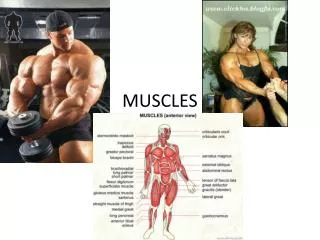
The human skeleton comprises 206 bones and serves various functions such as providing shape, support, and protection to internal organs, enabling movement through muscle attachment, producing blood cells, and storing minerals like calcium and phosphorus. The skeletal system is divided into the axial and appendicular skeletons. There are various joint types, including immovable, pivot, ball-and-socket, hinge, and gliding joints, each facilitating different ranges of motion. In addition, the human body contains approximately 639 muscles, which can be voluntary or involuntary, working together to facilitate movement and maintain stability.

E N D
Functions of the skeletal system • Give shape & support • Protect internal organs • Moves muscles • Form blood cells • Store calcium and phosphorous
Bone Cross Section Periosteum: soft, thin, covers and protects the bone Compact Bone: Hard, outer surface. Can heal itself when broken Spongy Bone: Porous, contains blood vessels, nerves Marrow: manufactures red blood cells
Skeletal System is divided into two parts
Axial Skeleton • Skull (protects the brain). • Ribs ( protect lungs, and heart). • Spinal column (houses and protects the spinal cord).
Appendicular Skeleton • Legs • Pelvis • Arms • Shoulders
Types of Joints • Immovable • Skull • Pelvis • Movable • Pivot • Ball & socket • Hinge • Gliding
Ball & Socket: Shoulders and Hips • Allows arms and hips to move in any direction • Can move in a full 360 degrees
Pivot Joints: First two neck vertebrae & joint beneath elbow • Moves in a semicircle motion by twisting against each other
Hinged: Elbows & Knees • Move like hinges on a door • Limited movement • Can only swing back and forth
Gliding Joints: Spine, Wrists, Ankles • Slide against each other in a gliding motion • Gives your wrists and ankles lots of freedom
http://www.lifesci.utexas.edu/faculty/sjasper/images/john21.19.jpghttp://www.lifesci.utexas.edu/faculty/sjasper/images/john21.19.jpg
http://www.bmb.psu.edu/courses/bisci004a/tissues/skeletal.jpghttp://www.bmb.psu.edu/courses/bisci004a/tissues/skeletal.jpg
http://www.sc.edu/union/Sears/AnimalTissue/im.tissueCardiac.jpghttp://www.sc.edu/union/Sears/AnimalTissue/im.tissueCardiac.jpg
Muscle Fiber Muscle Myofibril Inside a Muscle
Appendicular • The part of your skeleton made up of your arms, legs, pelvis and shoulders.
Axial • Part of your skeleton that includes skull, ribs, and spinal column.
Vertebrae • Irregular bones that make up the spinal column
Cartilage • Smooth tissue that acts as a buffer between bones.
Ligaments Tissues that fasten your bones together
Calcium • The mineral found in bones
Periosteum • The outer covering of bones.
Ball and Socket • These joints are found in hips and shoulders.
Gliding • These joints are found in fingers and the spine.
Immoveable • This type of joint is found in the skull and is fixed.
Pivot • These types of joints are found in the head and arms.
Voluntary • These muscles can be controlled consciously
Hinge • These joints are found in elbows and knees.
Involuntary • These muscles can be controlled unconsciously
Skeletal • Muscle tissue that is attached to bones and causes movement.
Smooth • This type of tissue lines the walls of many organs and are involuntary.
Cardiac • Muscle tissue found in the heart.
Tendons • These tough bands of connective tissue connect bones to skeletal muscles.
Strain • An injury caused when a muscle is over stretched.
Cramp • This can be painful and is sometimes caused by too much exercise and not warming up properly.