XP-746: ELM characterization in NSTX
60 likes | 172 Vues
This report details the experimental results from NSTX, focusing on the characterization of Edge Localized Modes (ELMs). The study aimed to measure and analyze the evolution of ELMs, including their structure, filament formation, and propagation characteristics within the scrape-off layer (SOL). Using a variety of diagnostics, including fast-framing cameras and probes, the experiment successfully captured data on Type I, Type III, and Type V ELMs. The findings contribute to a better understanding of ELM-induced turbulence and recovery of inter-ELM profiles, aiding in the evaluation of ELM stability.


XP-746: ELM characterization in NSTX
E N D
Presentation Transcript
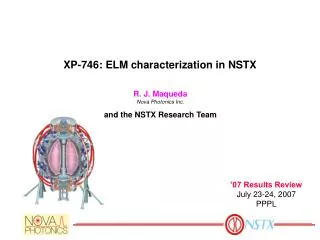
XP-746: ELM characterization in NSTX R. J. Maqueda Nova Photonics Inc. and the NSTX Research Team ’07 Results Review July 23-24, 2007 PPPL
XP-746: ELM characterization in NSTX XP Goals • Measure and characterize evolution of ELMs observed in NSTX: structure of ELM perturbed edge, birth of filamentary ELM structures, radial and poloidal/toroidal propagation in SOL, increase of edge turbulence and blobs, and recovery of inter-ELM profiles. • Obtain profiles for ELM stability evaluation. XP Summary • ½ run day on June 5th (17 shots: 124659-124675) • All 3 ELM Types produced and measuredType I: 124659-124664, 124669Type III: 124665-124668Type V: 124670-124675 • Good diagnostic availability:fast-framing cameras USXR arrays (JHU) static (ORNL/PPPL) and reciprocating (UCSD) probes reflectometers (UCLA) MIRNOV arrays (PPPL)
Fast-framing cameras show global and local evolution Fish-eye view no filter GPI view D2 puff - Da filter TYPE V ELMs Shot 124675 TYPE III ELMs Shot 124667 Lower divertor Da (a.u.) TYPE I ELMs Shot 124664 Time (s)
ELM filamentation after ELM onset GPI view no puff - Da filter ELM sequence • Mode growth. • Birth of ELM filaments. • Filament detachment (except in Type V ELMs). • Filament radial and poloidal/toroidal propagation in SOL – eventual interaction with plasma facing components. • Turbulent filamentation and blobs, L-mode like. • Recovery of H-mode edge. TYPE I ELM
ELM filamentation followed by L-mode like turbulence and blobs tELM + [200,300] ms tELM + [300,400] ms tELM + [400,500] ms tELM + [500,600] ms tELM + [600,700] ms Da emission (a.u.) dI/I Kurtossis Lpol (cm) TYPE III ELM Shot 124667 tELM ~ 275.02 ms Drsep (cm) Drsep (cm) Fluctuation levels, auto-correlation lengths and kurtossis similar to L-mode
Summary ...work in progress... XP-746 run time shots and diagnostic availabilty provide excellent opportunity to meet XP goals • Characterization of ELM mode structure, evolution into filaments, and propagation of filaments in SOL. • Characterization of ELM filaments and associated transport. • Characterization of post-ELM turbulence (blobs) and related transport. • Availability of profile data for stability analysis.