Understanding MPLS VPNs: Cost-Effective Virtual Connectivity Solutions
MPLS VPNs transform dedicated links into virtual point-to-point connections over shared infrastructure, lowering operating costs for businesses. These VPNs are classified based on specific business needs or connectivity requirements. They utilize Route Distinguishers (RDs) to create unique customer addresses and rely on Route Targets (RTs) for traffic forwarding. Provider Edge (PE) routers enable customer VPN routing through Multi-Protocol Border Gateway Protocol (MP-BGP), while Customer Edge (CE) routers implement standard IP routing protocols. Label stacking efficiently forwards packets in the MPLS VPN backbone.

Understanding MPLS VPNs: Cost-Effective Virtual Connectivity Solutions
E N D
Presentation Transcript
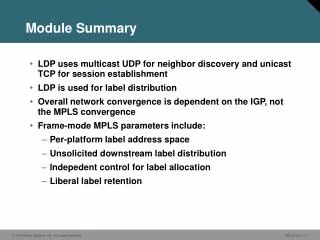
Module Summary • VPNs replace dedicated links with virtual point-to-point links on common infrastructure, reducing operating costs for customers. • VPNs are categorized based on business need or connectivity requirement. • MPLS VPNs prepends RDs to make unique customer addresses, and forwards traffic based on RTs. • PE routers provide customer VPN routing and services through MP-BGP, while CE routers run standard IP routing protocols • Label stacking is used in forwarding packets across the MPLS VPN backbone.