Overview of LDP in MPLS Networking: Multicast, Unicast, and Label Distribution
LDP (Label Distribution Protocol) employs multicast UDP for neighbor discovery and unicast TCP for establishing sessions. It is essential for label distribution, enabling efficient data forwarding in MPLS networks. Notably, network convergence relies more on the IGP (Interior Gateway Protocol) rather than MPLS convergence. Key frame-mode MPLS parameters include per-platform label address space, unsolicited downstream label distribution, independent control for label allocation, and liberal label retention to enhance network performance and resource management.

Overview of LDP in MPLS Networking: Multicast, Unicast, and Label Distribution
E N D
Presentation Transcript
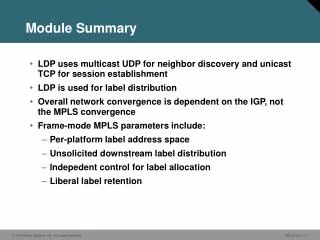
Module Summary • LDP uses multicast UDP for neighbor discovery and unicast TCP for session establishment • LDP is used for label distribution • Overall network convergence is dependent on the IGP, not the MPLS convergence • Frame-mode MPLS parameters include: • Per-platform label address space • Unsolicited downstream label distribution • Indepedent control for label allocation • Liberal label retention