Download
1 / 15
150 likes | 263 Vues
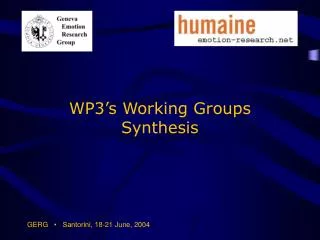
The first HUMAINE workshop, held in Geneva from June 17-19, 2004, focused on 'Theories and Models of Emotion' through three working groups. WG1 addressed conceptual clarifications, led by David Sander, clarifying emotions' terminologies and definitions. WG2, chaired by Klaus Scherer and Etienne Roesch, examined computational modeling of emotions and bridging gaps between disciplines. WG3, under Tanja Bänziger, focused on emotional communication skills, assessing human performance, and developing benchmarks for automatic recognition systems. Insights evolved into comprehensive proposals to enhance emotional understanding in human-computer interaction.

E N D
Geneva, 17-19 June, 2004 First HUMAINE workshop: “Theories and Models of Emotion” • WG1 “Conceptual and terminological clarifications” Chair: David Sander (david.sander@pse.unige.ch) • WG2 “Emotion and computational modeling” Chair: Klaus Scherer, Etienne Roesch (etienne.roesch@pse.unige.ch) • WG3 “Emotional communication skills” Chair: Tanja Bänziger (tanja.banziger@pse.unige.ch)
WG1 “Conceptual and terminological clarifications” • David Sander (david.sander@pse.unige.ch) • Take advantage of the multi-facets of HUMAINE (e.g., multi-disciplinary, multi-cultural) • Outcomes: 2 types of documents, • Clarifications of a finite and agreed set of concepts and operational definitions • Research documents: comparative studies among the HUMAINE community
A design-feature approach to define the different types of affect Table 1. Scherer (2004). HUMAINE Plenary Meeting. DFKI, Saarbrücken, March 1-3, 2004.
Spatial distribution of emotion-relevant concepts Aim: to define concepts using a similarity/difference approach • Hierarchy = Collection of components/concepts • Concept = {sub-components ; features} • Inheritance rules, would allow to define what is and what is not • Super-ordinate/Adjacent/Sub-ordinate concepts • Overlapping concepts
Now, define “emotion-relevant concepts” !.. • Finite set of consensual/useful concepts (i.e., operationaliz-able concepts) • Deliverables WP3, WP5 • .. in different contexts: theoretical understanding, applications, computational, et cetera ..
WG2 “Emotion models and computational modeling” • Klaus Scherer, Etienne Roesch (etienne.roesch@pse.unige.ch) • Grounded on the “failures” in attempts to implement/misunderstandings brought up during dialogs between engineers and theorists (numerous theories/interpretations) Need to bridge theoretical/conceptual gaps, in order to allow dialog between disciplines
Exemplar 1: a cohesive approach to conceptualization of emotions What model for what purpose?
Exemplar 2: “Blueprint for an affectively competent agent” • Fruitful dialog between Ethology, Cognitive Neuroscience, Computer Science, Philosophy, and Psychology • Detailed specifications and proposals about what an affective agent should be able to do (information processes to be implemented, norms, values, etc)
Exemplar 2: “Blueprint for an affectively competent agent” • Comprehensive document: an edited book • Gather descriptions of computational modules to be implemented (e.g., motivation, goals, values) • Theoretical perspectives (e.g., psychological, philosophical, ethological) • Technical (engineering) perspectives (i.e., implementation attempts)
Recommendations to ECAs designers ECAs should focus on the communicative function of emotions • “generative” approach, focused on the synthesis of emotions • “peripheral” approach, focused on defining the relevant cues to be used in HCI (emphasis on multi-modality) Link with WG3 “Emotion communication skills”
WG3 “Emotional communication skills” Assessment of Human Performance Assessment of Automatic Recognition Emotional sensitivity/recognition • number of categories • contexts • dealing with confusions • multiple channels • comparison groups Planned outcome (exemplar) Recommendations for the benchmarking of automatic recognition systems. Norms for different groups (?)
Current directions • complex expressions • few examples • non standard contexts labelling annotation Innovative approach to assessment of sensitivity ? • broad distinctions • large corpora • restricted contexts Compare performance and cue utilization of automatic vs human discrimination automatic recognition Two types of interests How are they perceived ? How large are individual differences ? How does one define skill/success ? What are the specific constraints on a system (in a given context) ? What benefits from a more informed approach ?
“From signs to emotions and vice-versa: Related exemplars from HUMAINE WP’s” Signals-to-Signs related exemplars: • WG2 • “Blueprint for an affectively competent agent” • WG3 • “Benchmarking of automatic emotion recognition systems”