Aging Behavior of Electrons in Silicon Transistors: A Study of Non-Equilibrium Dynamics
The far-from-equilibrium behavior of electrons in silicon transistors has been explored to understand complex non-equilibrium dynamics. This important study reveals that electrical conductivity (σ) in these transistors not only varies with time (t) but is also influenced by the measurement history (aging). The research showcases that the conductivity changes significantly after temporary modifications in electron density and temperature, indicating complex dynamics akin to other out-of-equilibrium systems. This work enhances the understanding of nonequilibrium phenomena, crucial for advancing electronic materials theories.

Aging Behavior of Electrons in Silicon Transistors: A Study of Non-Equilibrium Dynamics
E N D
Presentation Transcript
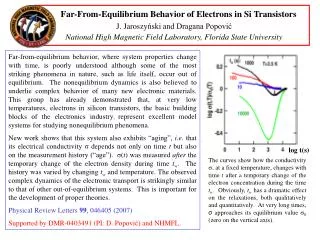
log t(s) Far-From-Equilibrium Behavior of Electrons in Si TransistorsJ. Jaroszyński and Dragana PopovićNational High Magnetic Field Laboratory, Florida State University Far-from-equilibrium behavior, where system properties change with time, is poorly understood although some of the most striking phenomena in nature, such as life itself, occur out of equilibrium. The nonequilibrium dynamics is also believed to underlie complex behavior of many new electronic materials. This group has already demonstrated that, at very low temperatures, electrons in silicon transistors, the basic building blocks of the electronics industry, represent excellent model systems for studying nonequilibrium phenomena. New work shows that this system also exhibits “aging”, i.e. that its electrical conductivity σ depends not only on time t but also on the measurement history (“age”). σ(t) was measured after the temporary changeof the electron density during time tw. The history was varied by changing tw and temperature.The observed complex dynamics of the electronic transport is strikingly similar to that of other out-of-equilibrium systems. This is important for the development of proper theories. Physical Review Letters 99, 046405 (2007) Supported by DMR-0403491 (PI: D. Popović) and NHMFL. The curves show how the conductivity , at a fixed temperature, changes with time t after a temporary change of the electron concentration during the time tw. Obviously, tw has a dramatic effect on the relaxations, both qualitatively and quantitatively. At very long times, σ approaches its equilibrium value 0 (zero on the vertical axis).