Phase Transitions in the Early Universe ^and Late QM2008, Jaipur, Feb. 5th, 2008 John Ellis
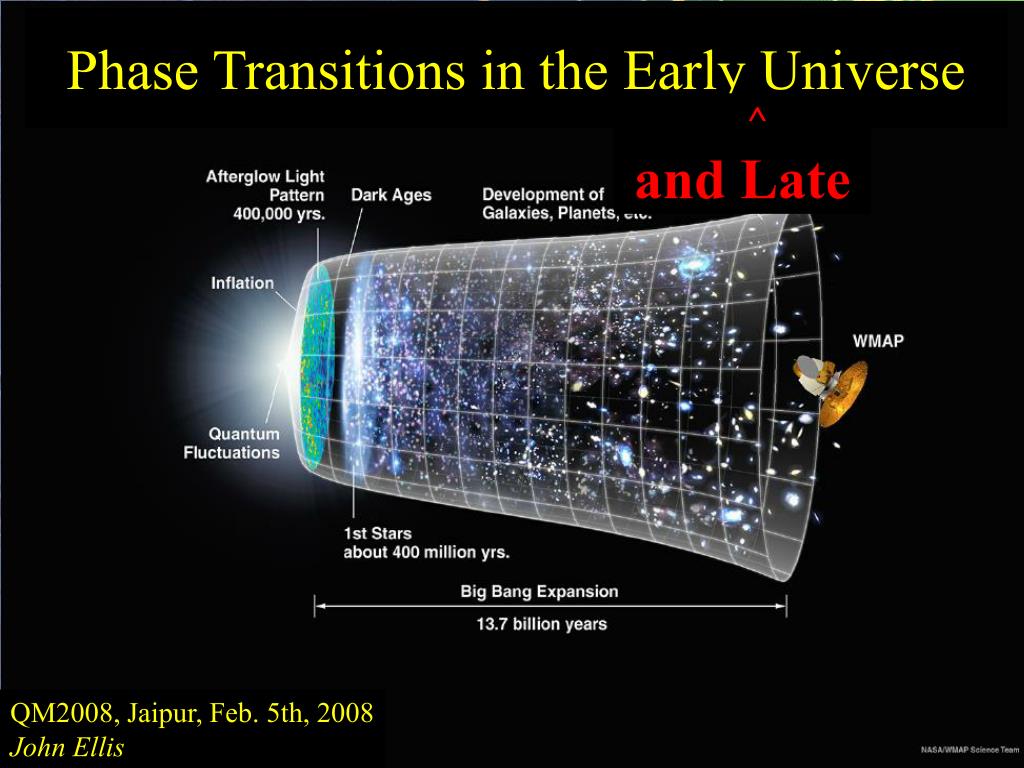
The CMB according to WMAP Image of Universe at recombination (atom formation, not itself a phase transition) Lumpiness due to earlier transition
300,000 years Recombination: Birthof atoms 3 minutes Nucleosynthesis: Birthof nuclei Quark-hadron phase transition 1 micro- second Electroweak phase transition: Birth of matter? 1 pico- second Inflation? Birth of Stucture?
Collide heavy nuclei at high energies to create … Hot and Dense Hadronic Matter Properties described by string theory ideas: viscosity, jet quenching, …? Recreate the first 10-6 seconds … … and probe the quark-hadron phase transition
AdS/CFT Approach to QGP • Gauge theories in 4 dimensions related to (suitably chosen) gravity/string theory in 5 dimensions: g: = 5 A • Rigorous for N= 4 supersymmetry (scale-invariant conformal field theory) • Heuristic for realistic QCD • Interest because strong gauge coupling weak string coupling • Reliable calculations for strongly-coupled QGP?
Early Heuristic Discussion
Black Holes in 5 Dimensions • Consider 5-dimensional AdS space, radius b, metric: • 4 Newton constant • Black holes stable if temperature T > T1 = 1/b • Outer horizon of BH = r+ • Consider two limits: b << r+, b >> r+ JE, A.Ghosh, Mavromatos
Black Hole Equation of State • High-temperature limit b << r+ • Partition function • Effective potential • van der Waals equation of state • Suggestive of phase transition • Approximate density, pressure JE, A.Ghosh, Mavromatos
Combined Picture of Transition • Reminiscent of lattice results • New insight into underlying dynamics? • Calculational tool for QGP? JE, A.Ghosh, Mavromatos
AdS/CFT for N = 4 SUSY Gauge Theory • N = 4 SUSY QCD has fixed coupling • Rigorous AdS/CFT correspondence at large (∞, 1/ corrections), large Nc • Can be used to calculate Wilson loops • Related to static and dynamic quantities • Promising comparison with knowledge of QCD for T ~ 1.2 to 2.5 Tc • Challenge to extend to realistic QCD
Viscosity in N = 4 SUSY Gauge Theory • Potentially interesting for cosmological QCD transition: not yet explored Very small at large coupling Lower than other fluids! Kovtun, Son, Starinets
Comparison with Lattice Calculations • N = 4 result similar to lattice for T ~ 2 Tc • But trace anomaly ≠ 0 QCD not conformal
Electroweak Phase Transition • Second order in the Standard Model for mH > 114.4 GeV • Strong first order needed for baryogenesis at the electroweak scale • Not enough CP violation anyway in the Standard Model • Both problems may be solved by SUSY
Generating the matter in the Universe Sakharov • Need difference between matter, antimatter C, CP violation seen in laboratory • Need matter-creating interactions present in unified theories – not yet seen • Need breakdown of thermal equilibrium possible in very early Universe e.g., in first-order phase transition Could a first-order electroweak transition be the culprit?
Electroweak Transition in SUSY • First order electroweak phase transition if additional light scalar • Most plausible candidate: light stop • Beware of development of stop v.e.v. • Parameter space very tightly constrained • Higgs and/or stop close to discovery Quiros
Baryogenesis in SUSY • Additional sources of CP violation • ‘Easy’ to get sufficient baryon/entropy • Favours relatively light CP-odd Higgs • Modest CP-violating phase is enough Quiros
Implications of SUSY Baryogenesis • mH < 120 GeV, 120 GeV < mstop < mt • 5 < tan < 10, small stop mixing • CP-violating phase ~ 0.1 • Important limits from electric dipole moments Balazs, Carena, Menon, Morrissey, Wagner
Implications for SUSY Dark Matter Scattering may be reduced as CP-violating phase Parameter region changes with CP violating phase Balazs, Carena, Menon, Morrissey, Wagner
Low-Energy Effects of CP Phases Bs Bu Different regions allowed for different phases … … and hence ACP in b s b s J.E. + Lee + Pilaftsis: arXiv:0708.2078
Cosmological Inflation • Theory to explain the size, age & uniformity of the Universe • Period of (near) exponential expansion driven by scalar field energy (1) • Quantum effects → CMB anisotropies, origins of structures • Subsequent reheating → matter (2) • Then matter-antimatter asymmetry generated
Origin of Structures in Universe Small quantum fluctuations: one part in 105 Gravitational instability: Matter falls into the overdense regions Convert into matter with varying density
The CMB according to WMAP Image of Universe at recombination (atom formation, not itself a phase transition) Lumpiness due to earlier transition
Higgs Mass and Inflation • Upper limit on Hubble expansion rate during inflation • Upper limit on reheating temperature from metastability Espinosa, Giudice, Riotto
A Phase Transition in the Future? • Our electroweak vacuum may be unstable if mH small (hinted by electroweak data) • Renormalization by top quark drives Higgs self-coupling < 0 at large <H> • Metastable vacuum, lifetime = f(mH, mt, s) • mH too small would have decayed • mH too large will ‘never’ decay • mH, mt, s just right: Big Bang Big Crunch
On our Way to a Big Crunch? Renormalization by top quark coupling mH = 125 120 115 105 GeV New vacuum with 0|H|0 > Big Crunch! Arkani-Hamed, Dubovsky, Salvatore, Villadoro
Is there a Big Crunch in Our Future? Present errors Future errors Big Crunch for mH = 114.4 GeV Eternal expansion Big Crunch! Big Crunch allowed @ 1.5 Arkani-Hamed, Dubovsky, Salvatore, Villadoro
Outlook • Phase transitions in early universe might have been very important: • Origin of structures • Origin of matter • Size of Universe, … (and there may be another in the future) • Quark-hadron transition only one directly accessible to experiment • Go to it!