Enhancing Branch Prediction Accuracy by Analyzing Mispredictions and Clustered Behaviors
This study investigates the impact of mispredictions in branch prediction, a critical component of modern pipelined architectures. It explores the phenomenon of clustered mispredictions—instances where consecutive predictions are incorrect—and assesses methods to improve predictor accuracy. By analyzing various predictors like GSHARE and LOCAL, we examine the role of correlations within prediction tables and identify problematic classes of branches. Our findings contribute insights into optimizing branch prediction strategies, reducing pipeline flushes, and enhancing overall system performance.

Enhancing Branch Prediction Accuracy by Analyzing Mispredictions and Clustered Behaviors
E N D
Presentation Transcript
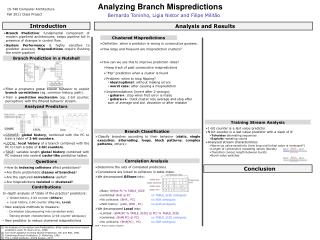
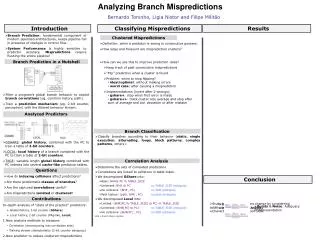
Analyzing Branch Mispredictions Bernardo Toninho, Ligia Nistor and Filipe Militão Results Introduction Classifying Mispredictions • Branch Prediction: fundamental component of modern pipelined architectures, keeps pipeline full in presence of changes in control flow. • System Performance is highly sensitive to predictor accuracy. Mispredictions require flushing the entire pipeline! Clustered Mispredictions • Definition: when a predictor is wrong in consecutive guesses. • How large and frequent are misprediction clusters? Branch Prediction in a Nutshell • How can we use this to improve prediction rates? • Keep track of past consecutive mispredictions • “Flip” prediction when a cluster is found • Problem: when to stop flipping? • ideal/optimal: without making errors • worst case: after causing a misprediction • Implementations (invert after 2 wrongs): • gshare+: stop when first error is made • gshare++: track cluster size average and stop after sum of average and std. deviation or after mistake • Filter a program’s global branch behavior to exploit branch correlations (eg. common history, path). • Train a prediction mechanism (eg. 2-bit counter, perceptron) with the filtered behavior stream. Analyzed Predictors Branch Classification • Classify branches according to their behavior (static, single execution, alternating, loops, blockpatterns, complex patterns, others): • GSHARE: global history, combined with the PC to train a table of 2-bit counters. • LOCAL: local history of a branch combined with the PC to train a table of 2-bit counters. • TAGE: variable length global history combined with PC indexes into several cache-like prediction tables. Correlation Analysis • Determine the sets of correlated predictions • Correlations are linked to collisions in table index. • We decomposed GShare into: • Base: BHR⊕ PC % TABLE_SIZE • Unlimited: BHR ⊕ PCno TABLE_SIZE ambiguity • No collisions: (BHR , PC)no XOR ambiguity • Path history: (path, BHR , PC)no path ambiguity • We decomposed Local into: • Limited: (BHR[PC % TABLE_SIZE] ⊕ PC) % TABLE_SIZE • Unlimited: (BHR[PC] ⊕ PC)no TABLE_SIZE ambiguity • No collisions: (BHR[PC] , PC)no XOR ambiguity • BHR = Branch History Register Questions • How do indexing collisions affect predictions? • Are there problematic classes of branches? • Are the captured correlations useful? • Are mispredictions isolated or clustered? Conclusion Contributions • Study how the correlations change by considering additional data (path, PC, history) • Characterize the correlation sets: • Branch class(es) • Prediction Stream Analysis • In-depth analysis of “state of the practice” predictors: • Global history, 2-bit counter (GShare) • Local history, 2-bit counter (PAg-like, Local) • New analysis methods to measure: • Correlation (decomposing into correlation sets) • Training stream characteristics (2-bit counter adequacy) • New predictor to reduce clustered mispredictions • Bursts & Noise: Adequacy of Representation