Management of HCV Treatment in 62-Year-Old Male with Cirrhosis: Case Report on Drug Interactions
This case report discusses a 62-year-old man diagnosed with chronic hepatitis C genotype 1b and cirrhosis, who was initiated on triple therapy with Peginterferon, Ribavirin, and Telaprevir. Despite achieving undetectable HCV RNA at Week 4, he developed ankle swelling and hematemesis due to esophagitis. Intubation was required due to respiratory distress, likely linked to interactions with Midazolam, a CYP3A4 substrate. This case exemplifies the importance of monitoring drug interactions in patients undergoing antiviral therapy for hepatitis C.

Management of HCV Treatment in 62-Year-Old Male with Cirrhosis: Case Report on Drug Interactions
E N D
Presentation Transcript
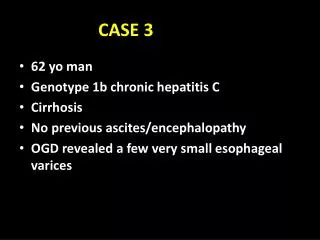
CASE 3 • 62 yo man • Genotype 1b chronic hepatitis C • Cirrhosis • No previous ascites/encephalopathy • OGD revealed a few very small esophageal varices
CASE 3 • Therapy was initiated with triple therapy including PEGINF/RBV/Telaprevir • Baseline HCVRNA…3.6510E5
CASE 3 • Week 0 HCVRNA…3.65x10E5 • Week 4 HCVRNA…<12 • Begins to develop swelling of ankles at week 5 and at week 6 develops hematemsis
CASE 3 • OGD arranged…prepared in the usual fashion • Bleeding seemingly coming from esophagitis and not varices
CASE 3 • Patient noted to be unable to protect airway and develops apneic episodes …requires intubation/respiratory support for 24 hrs CAUSE??
Interactions with Midazolam • Midazolam is a CYP3A4 substrate • susceptible to interactions with inhibitors • 2.5 to 5-fold AUC with saquinavir • 5 to 9-fold AUC with boceprevir or telaprevir • case report of prolonged sedation with midazolam + SQV requiring flumazenil • Midazolam is contraindicated with HIV and HCV protease inhibitors • Alternatives: lorazepam (Ativan) orpropofol (Diprivan) [AIDS 1997;11:268-9; Victrelis & Incivek Product Monographs, 2011]
Summary • High potential for pharmacokinetic interactions between directly acting antivirals and other drug classes • Steps to minimize/manage interactions: • ensure medication records are up to date at each visit (medication reconciliation) • use a systematic approach to identify combinations of potential concern • consult pertinent drug interaction resources, pharmacology/pharmacy specialists • consider therapeutic drug monitoring (if available) • patient counselling & close monitoring