Download
1 / 8
80 likes | 197 Vues
This resource covers essential concepts in chemistry regarding balancing reactions and counting atoms. Students will learn how to determine the number of oxygen, sulfur, calcium, nitrogen, carbon, and lead atoms in various compounds through structured practices. The agenda also features homework assignments such as completing worksheets and reading guides on conservation of mass. Additionally, supplementary video resources are provided to reinforce learning. This comprehensive guide ensures students understand the methods involved in balancing chemical equations effectively.

E N D
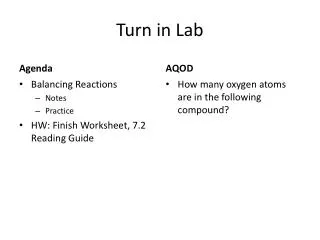
Turn in Lab Agenda AQOD How many oxygen atoms are in the following compound? • Balancing Reactions • Notes • Practice • HW: Finish Worksheet, 7.2 Reading Guide
Turn in Lab Agenda (5th hour) AQOD How many oxygen atoms are in the following compound? • 7.2 Reading Guide on Balancing Reactions • 7.2 Worksheet • HW: Finish worksheet
Conservation of Mass • http://www.youtube.com/watch?v=J5hM1DxaPLw • http://www.youtube.com/watch?v=dExpJAECSL8
Practice Counting Atoms • How many sulfur atoms? • How many oxygen atoms?
Practice Counting Atoms • How many calcium atoms? • How many nitrogen atoms?
Practice Counting Atoms • How many carbon atoms? • How many oxygen atoms? • How many lead atoms?
Box Method - Steps • Look at the first item in the equation • Write down the symbols of each element present the number of times it appears in the formula • Put a box around it • Repeat for each item in the equation • Check if mass is conserved • Add boxes until there are the same number of each atom on each side
Line Method - Steps • 1. List out the atoms • 2. Count the number of each type of atom in the reactant • 3. Count the number of each type of atom in the product • 4. Note which atoms are not balanced • 5. Select one atom to balance • 6. Update the atom counts • 7. Repeat steps 4-6 until all are balanced