Download
1 / 18
190 likes | 322 Vues
NGSL project aims to create a comprehensive UV/optical spectral atlas of 600 stars, with detailed coverage of Luminosity, Effective Temperature, and Stellar Surface Gravity. Targeting stars across different metallicity ranges, the library provides high Signal-to-Noise ratios and stable calibration for stellar analysis. Challenges in calibration, flux calibration, contamination, and potential improvements are explored. The NGSL dataset is expanding, with upcoming releases including additional spectral modes and extensions to cover red giants and dwarfs from HST and VLT archives. 8 Relevant

E N D
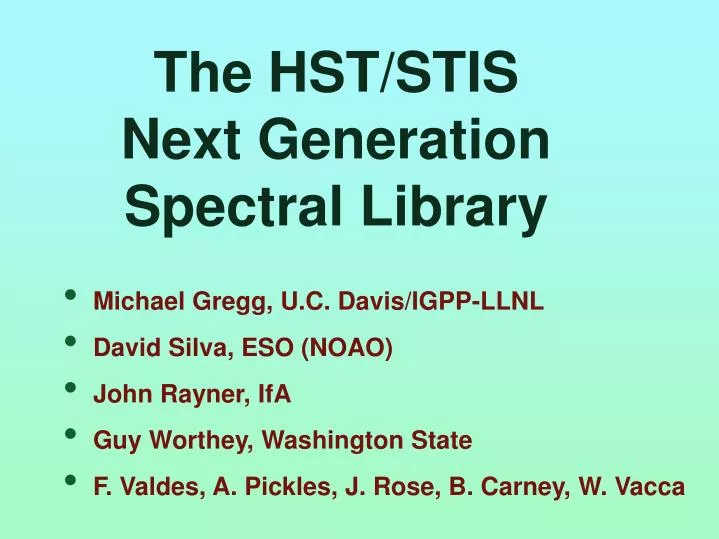
The HST/STISNext Generation Spectral Library • Michael Gregg, U.C. Davis/IGPP-LLNL • David Silva, ESO (NOAO) • John Rayner, IfA • Guy Worthey, Washington State • F. Valdes, A. Pickles, J. Rose, B. Carney, W. Vacca
NGSL Proposed: • Snapshot program to produce a UV/Optical stellar spectral atlas of 600 stars • STIS Low Resolution modes: G230LB, G430L, G750L • High S/N • Stable HST calibration • Good coverage of L, Teff, log(g) with 150 stars in each of 4 abundance intervals: [Fe/H] < -1.5 -1.5 < [Fe/H] < -0.5 -0.3 < [Fe/H] < 0.1 [Fe/H] > 0.2
NGSL Realized: • Cycle 10: 300 snapshots, 156 observed • Cycle 12: 450 snapshots, 208 observed • Cycle 13: 450 snapshots, 17 observed • Total of 380 targets
NGSL Calibration Challenges • No Wavecals (on purpose) • E1 Aperture, 0.2” slit • Fringing • G230LB Red Light Contamination • $%&# Fits Table Format
No Wavecals • All targets have known V_rad • Cross correlate to find SHIFTA1 • Shift to published V_rad • De-redshift • $%&# Fits Table Format
E1 Aperture, 0.2” slit • Absolute calibration • Relative calibration between gratings • Mis-centered observations • $%&# Fits Table Format
Flat Fielding / Fringing • Modified versions of CALSTIS routines • Flux calibration would be improved by using flats to take out high order response at blue end of G750L • Fringe removal is improved by subtracting scattered light from fringe flat
G230LB Red Light Contamination • Zeroth order image wings overlap G230LB blue end • FOS had similar (but different) trouble • Affects bright red targets the most
G230LB Contamination: • Not a DC correction as for FOS • Contamination increases to the red => important components besides zero order image • Sloping straight line scaled to V magnitude works over limited color range • Need to develop sophisticated correction
What’s Coming... • G430L + G750L release • UV addition • Fill out red giants & dwarfs from HST archive • Add far UV from HST & IUE archive • VLT/UVES extension • IRTF/SPEX extension • Interpolated, semi-empirical spectral library