Applications of Raman Spectroscopy in Material Science and Nuclear Physics
150 likes | 252 Vues
This presentation by Mr. Abd El mo’ez Ahmed Mohammed from Sohag University discusses the principles and applications of Raman spectroscopy, particularly in tissue characterization, imaging, and live cell imaging. It explores the mechanism of Raman scattering and the significance of energy transfer in molecular vibrations. The presentation highlights how Raman spectroscopy enables insightful analysis without the need for dyes, making it a valuable tool in both material science and nuclear applications. Acknowledgments are made to the supervisory and technical support received throughout the study.


Applications of Raman Spectroscopy in Material Science and Nuclear Physics
E N D
Presentation Transcript
Mr/ Abd El mo’ez Ahmed Mohammed“3th group” “Neutron physics and application in material scienceand nuclear application”physics departmentFaculty of ScienceSohag University Egypt Physics Department Faculty of Science
JINR’s group Supervisor : prof . S.I. Tutunnikov. Technician : Mr. Kovalev Yura.
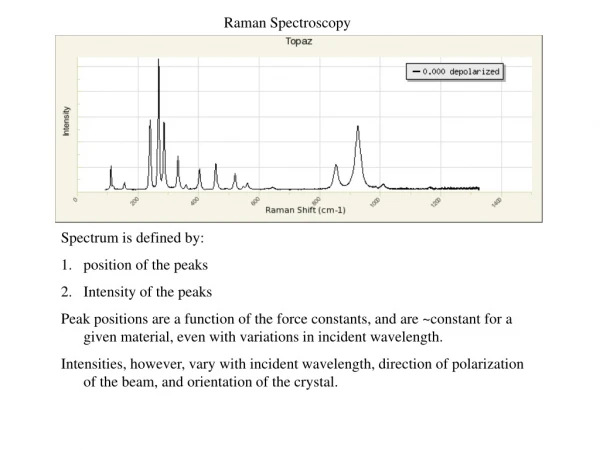
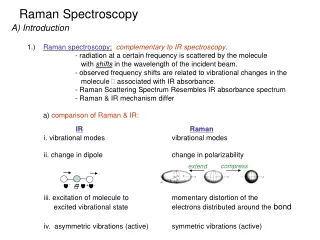
Why we use Raman spectroscopy? Raman spectroscopy is used to determine the molecular motions, especially the vibrational one .
Now what is the application? We can use Raman spectroscopy in:- Tissue characterization. Tissue Imaging. Live Cell Imaging.
Live Cell Imaging All the sexiness, without the dyes!!
difference in energy hn h(n (-+) n1) 3 2 1 0 S1 3 2 1 0 S0 hn Inelastic Scattering Virtual Level • Energy transferred from incident light to molecular vibrations Energy Rayleigh Raman (inelastic) (elastic) Scattering Scattering
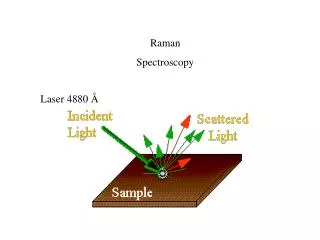
Raman spectrometer’s mechanism. The laser beam falls on the filter and then it passes to the objective and collides with the Sample. The light will be scattered in all directions and will be reflected to the objective again. After the reflected light reaches the objective it falls down on the spectrometer system and finally to the CCD or PMT detectors.
Acknowledgement Finally I’d like to thank 1- Mr/ Kovalev Yura. 2- Mr/ Valantine. for their help and efforts.