Understanding Momentum and Impulse: Concepts, Demonstrations, and Applications
Explore the fundamental concepts of momentum and impulse in this engaging guide. Momentum, defined as the product of mass and velocity (p = mv), indicates an object's motion state. Discover the factors affecting momentum and its implications when an object is in motion. Through interactive demonstrations like the Balloon Toss and Egg Launch Lab, learn about impulse, the change in momentum, and how to minimize impact forces. These activities illustrate the principles in action, ensuring a comprehensive understanding of momentum and impulse essential for physics.

Understanding Momentum and Impulse: Concepts, Demonstrations, and Applications
E N D
Presentation Transcript
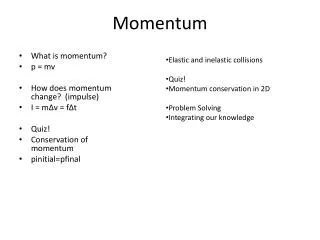
Just a few Q’s • What is your understanding of momentum? • What factors cause an object to have momentum? • If an object has momentum, what does that tell you about it?
Notes:Momentum: Momentum is like inertia in motion. Momentum = Mass x Velocity Or p = mv Problem: A .2kg baseball approaches the plate with a velocity 20m/s. Find its momentum.
Balloon Toss Demo: Get a partner and fill one balloon. Referrals to those who throw them at each other.
Impulse: Change in momentum Derivation: When objects are stopped slowly….. When objects are stopped quickly….. (Demo: Desk Jump)
Sample Problem 1: Find the following for a .5kg baseball when colliding with a wall and coming to a stop from 10m/s. • Impulse b) Force to stop in .009s
Sample Problem 2: Find the following for the .5kg ball: a) Change in momentum b) Impulse c) Force to stop in .009s
Reduce the impact force, so don’t forget to wear your helmet!
Warm-up: Find the Impulse for Each Situation. The mass of the car is 1000kg
Impulse Demos: • Egg toss • Chair Jump • Balloon Toss
Egg Launch Lab Objective: Wrap three eggs in a container so that when launched against a wall, they will not break. Grading: No eggs break- 20/20 1 egg breaks – 17/20 2 eggs break – 14/20 3 eggs break – 10 /20