
SlideServe
Menu
Préférences
© SlideServe · v2026

Understanding Mass Balance in Non-Isolated Systems: Mass Transport and Equilibrium Conditions

vidor avatar
18 diapositives · 346 Views · Aug 14, 2014

This document explores the principles of mass balance within non-isolated systems, focusing on mass flows and the effects surrounding phase changes. Key concepts discussed include mass transport via convection and diffusion, and how these processes help achieve new equilibrium after alterations in pressure and temperature. The mass balance equations and their implications for various species in ideal systems are addressed, alongside discussions of momentum and energy balances. Understanding these principles is crucial for applications in fields such as chemical engineering and environmental science.
Understanding Mass Balance in Non-Isolated Systems: Mass Transport and Equilibrium Conditions - slide 1
01 / 18Understanding Mass Balance in Non-Isolated Systems: Mass Transport and Equilibrium Conditions
1 / 17

Télécharger la présentation

Understanding Mass Balance in Non-Isolated Systems: Mass Transport and Equilibrium Conditions
Une image / un lien ci-dessous est fourni (tel quel) pour télécharger la présentation

Politique de téléchargement : le contenu du site vous est fourni TEL QUEL pour votre information et votre usage personnel ; il ne peut être vendu, concédé sous licence ni partagé sur d’autres sites sans l’accord de son auteur.Le contenu vous est fourni TEL QUEL, pour votre information et votre usage personnel uniquement. Téléchargez la présentation en cliquant sur ce lien. Lors du téléchargement, si vous ne parvenez pas à télécharger une présentation, l’éditeur a peut-être supprimé le fichier de son serveur.Pendant le téléchargement, si vous ne parvenez pas à obtenir une présentation, le fichier a peut-être été supprimé par l’éditeur.

F I N

Plus de contenu associé

Transcription de la présentation
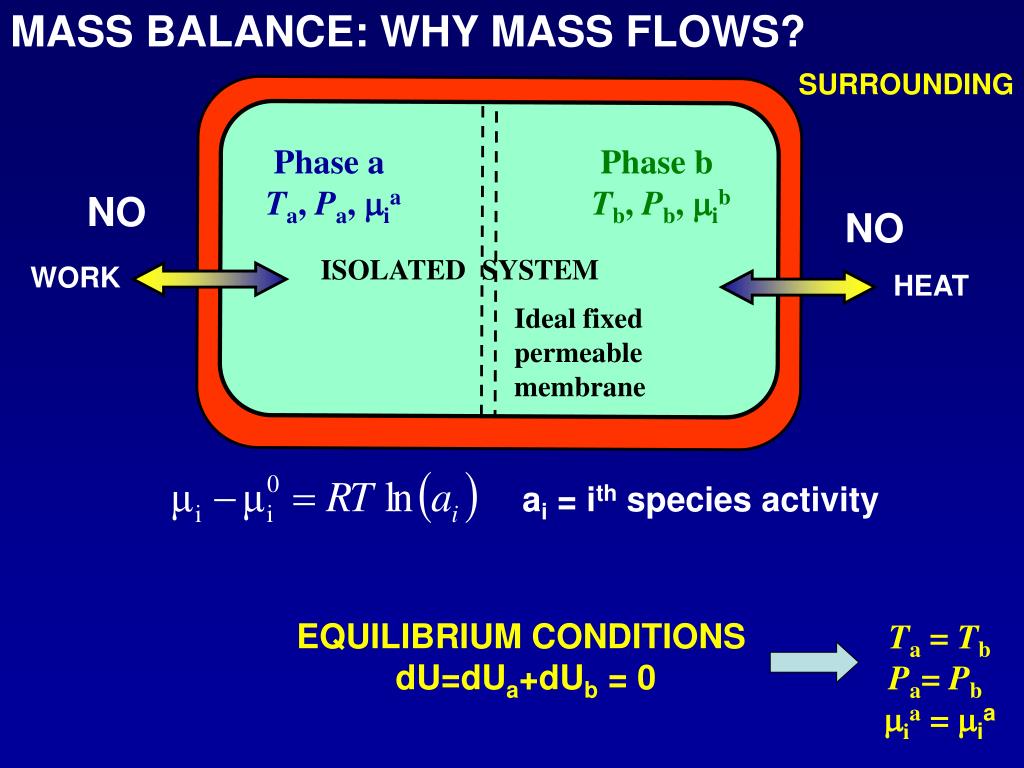
  1. MASS BALANCE: WHY MASS FLOWS? SURROUNDING Phase a Ta, Pa, mia Phase b Tb, Pb, mib NO NO ISOLATED SYSTEM WORK HEAT Ideal fixed permeable membrane ai = ith species activity Ta = TbPa= Pb mia = mia EQUILIBRIUM CONDITIONS dU=dUa+dUb = 0

  2. MASS BALANCE: EQ.CON. ALTERATION 1 Pa increase (>Pb) [Ta = Tb; mia = mib] Phase a T, Pa, mi Phase b T, Pb, mi MASS TRASPORT (CONVECTION) permeable membrane

  3. mia>mib [Ta = Tb; Pa = Pb] 2 Phase a T, P, mia Phase b T, P, mib permeable membrane MASS TRASPORT (DIFFUSION) Mass transport represents a possible way the system has to get new equilibrium conditions once the original ones have been altered.

  4. MASS BALANCE Z X Y DZ DX (X+DX, Y+ DY, Z+ DZ) G (X, Y, Z) DY (X, Y+ DY, Z) (X+DX, Y+ DY, Z)

  5. MASS BALANCE: EXPRESSION DX DZ (X, Y, Z) G DY Ci = f(X, Y, Z, t)

  6. DX DZ (X, Y, Z) G DY DIVIDING FOR DV

  7. FLUXES EXPRESSIONS Ideal solution Diffusion Diffusion Diffusion Convection Convection Convection Bi = mobility of the diffusing components

  8. Remembering that:

  9. MASS BALANCE EQUATION FOR ith SPECIES where: Remembering the definition of the NABLA operator:

  10. As: … the summation of ith mass balance over all the r components yields to the well known continuity equation:

  11. MASS BALANCE: CYLINDRICAL COORDINATES Jir+dr Jir+dr Jiz Jiz+dz Jir Jir Jir Jiz Jiz+dz Jir+dr r dr dz TWO DIMENSIONS r z

  12. Ci = f(z, r, t) r dr dz Dividing by 2prdrdz

  13. Constant diffusion coefficient D Remembering the derivativedefinition

  14. MOMENTUM BALANCE Incoming sand Escaping sand Sand containing vessel Sliding vessel motion direction Inclinate plane Friction Gravity NO Yes

  15. DZ DX (X+DX, Y+ DY, Z+ DZ) (X, Y, Z) DY (X, Y+ DY, Z) (X+DX, Y+ DY, Z) Body forces: gravitational, electro-magnetic fields Surface forces: viscous drag and pressure

  16. Surface forces gravitational field Incoming and exiting mass

  17. ENERGY BALANCE Conduction Expansion Viscous heating