Understanding the Propaganda Model: Media Bias and the Influence of Elite Interests
This analysis explores the Propaganda Model by Herman and Chomsky, detailing how media ownership, advertising interests, and sourcing shape news narratives. It highlights media bias, including systematic biases such as partisan and ideological preferences, the official source bias in foreign affairs, and the spin bias focusing on sensationalism. The discussion includes historical case studies, particularly regarding Vietnam, to reveal how media coverage can reflect elite interests and influence public perception. Ultimately, it raises questions about the model's validity and the dynamics between media and public opinion.

Understanding the Propaganda Model: Media Bias and the Influence of Elite Interests
E N D
Presentation Transcript
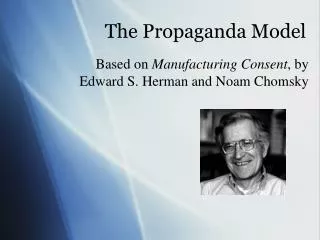
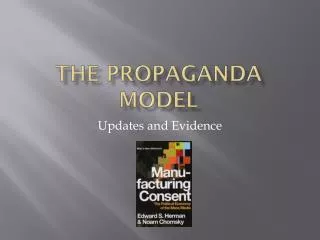
The Propaganda Model Updates and Evidence
I. The Model: Five filters • Corporate: Size and ownership limits stories that can be reported (owners are elite) • Advertising: Appeal to affluent audience, avoid killing the “buying mood” • Sourcing: Reliance on government and interest group PR (need for flows of information) • Flak: Institutions (e.g. AIM, embedding) to enforce discipline • Ideology (Anti-Communism Spread of Free Markets Anti-Terrorism): Need for “national religion”
Blogs: Elite drive, General reinforce, political and tail are driven
Top Blogs: Are they subject to the filters? • Top blogs and Top political blogs – Reliance on venture capital and advertisers.
II. Recent Findings on Media Bias • “Hostile Media Effect” – Most people think media is biased against their side • Systematic Bias: • Partisan Bias (preference for one party): Appears to be rare (ratios of positive:negative stories about each party roughly similar) • Ideological Bias (preference for left or right) • Some studies find right-wing (Fox, WSJ) or left-wing (NYT, CSM) bias BUT • Differences in news reports are quite small: Owners are conservative but reporters tend to be liberal • Opinion/editorial biases much more pronounced
4. “Politically-neutral” biases • Spin Bias: Great deal of evidence suggests focus on sensational events and scandals • Official Source Bias: Government sources overrepresented, particularly in foreign affairs stories (limited information, desire to preserve contacts)
C. Effect of Bias: Remarkably Small • Selection Effect: People choose to watch news sources with which they agree • Example: Availability of Fox News did not increase pro-conservative views among viewers. Instead, people who were already conservative tuned in. • “Neutral” Biases (Spin and Official Source) probably most influential: hard to filter out
III. The Vietnam Case: Recent Findings A. Style of reporting • 1965-1970 = 2300 evening news reports on Vietnam -- Only 76 showed both fighting and casualties within view • Gear prevented most close-up shots (nearly impossible to film while prone) or instantaneous reporting in the field (Vietnam was a videotape war). • All three networks agreed not to air recognizable images of US dead (feet only, not faces)
B. A New Kind of War? • Compare Korea and Vietnam support against casualties:
Battle-Deaths and Support for Wars Afghanistan Iraq
C. Media Bias and Opinion Journalism • Before Tet: Speakers in favor of war quoted 26.3% of the time, speakers against war quoted only 4.5% of the time • After Tet: 28.4% supporters, 26.1% opponents • Opponents: 49% are government officials, 16% are reporters expressing opinions, 35% are antiwar activists or soldiers • What happened? Bias towards official sources change in reporting when officials turned against the war • Media opposition actually lagged public opposition! Opponents consistently underrepresented compared to share of US population
IV. Evidence Against the Model • Public/elite gap? Herman responds (2000): “It is a model of media behavior and performance, not of media effects.” Problem: if no effects model, why do we care? • Reversing the causal arrow: The “CNN Effect” (news shapes and alters state policy, contrary to “official source bias”)
IV. Evidence Against the Model • Public/elite gap? Herman responds (2000): “It is a model of media behavior and performance, not of media effects.” Problem: if no effects model, why do we care? • Reversing the causal arrow: The “CNN Effect” (news shapes and alters state policy, contrary to “official source bias”) • General issue: Is the model falsifiable? “How much” opposition is required?
New Documentary • Archival footage: • Atomic Café: The firstminutes. • Zapruder – stabilized Zapruder • Compare: Bigfoot and Stabilized Bigfoot • Which is more “truthful?” • Is cinema verité a lie? Errol Morris critique…