

SlideServe
Menu
Préférences
© SlideServe · v2026

Dynamic Equilibrium

vincent-moody avatar
9 diapositives · 382 Views · Nov 08, 2014

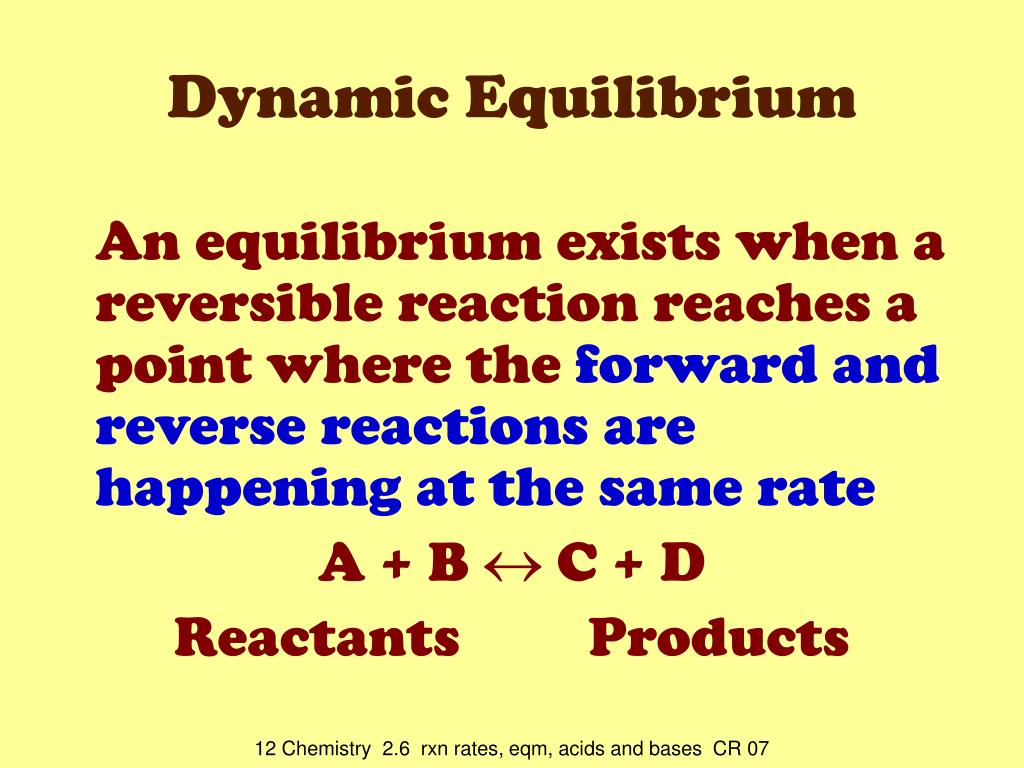
Dynamic Equilibrium. An equilibrium exists when a reversible reaction reaches a point where the forward and reverse reactions are happening at the same rate A + B  C + D Reactants Products. Dynamic Equilibrium.
Dynamic Equilibrium - slide 1
01 / 9Dynamic Equilibrium
1 / 17

Télécharger la présentation

Dynamic Equilibrium
Une image / un lien ci-dessous est fourni (tel quel) pour télécharger la présentation

Politique de téléchargement : le contenu du site vous est fourni TEL QUEL pour votre information et votre usage personnel ; il ne peut être vendu, concédé sous licence ni partagé sur d’autres sites sans l’accord de son auteur.Le contenu vous est fourni TEL QUEL, pour votre information et votre usage personnel uniquement. Téléchargez la présentation en cliquant sur ce lien. Lors du téléchargement, si vous ne parvenez pas à télécharger une présentation, l’éditeur a peut-être supprimé le fichier de son serveur.Pendant le téléchargement, si vous ne parvenez pas à obtenir une présentation, le fichier a peut-être été supprimé par l’éditeur.

F I N

Plus de contenu associé

Transcription de la présentation
  1. Dynamic Equilibrium • An equilibrium exists when a reversible reaction reaches a point where the forward and reverse reactions are happening at the same rate • A + B  C + D • Reactants Products 12 Chemistry 2.6 rxn rates, eqm, acids and bases CR 07

  2. Dynamic Equilibrium • We call this dynamic equilibrium because there are still forward and reverse reactions happening – the reaction mixture contains both reactants and products. • Even though there is no visible change there is still action = dynamic 12 Chemistry 2.6 rxn rates, eqm, acids and bases CR 07

  3. Closed System • To have an equilibrium you must have a closed system – this means that no reactants or products can leave the reaction container 12 Chemistry 2.6 rxn rates, eqm, acids and bases CR 07

  4. A + B  C + D • In this equilibrium: • A + B  C + D • C + D  A + B • Both reactions are happening simultaneously 12 Chemistry 2.6 rxn rates, eqm, acids and bases CR 07

  5. Dissolving CuSO4 • In a sealed jar CuSO4 crystals dissolve in water to make CuSO4 solution – if the solution is saturated then CuSO4 also comes out of solution 12 Chemistry 2.6 rxn rates, eqm, acids and bases CR 07

  6. Forward reaction: • CuSO4(s) + H2O  CuSO4(aq) • Reverse reaction: • CuSO4(aq)  CuSO4(s) + H2O • We write the equilibrium reaction: • CuSO4(s)  CuSO4(aq) 12 Chemistry 2.6 rxn rates, eqm, acids and bases CR 07

  7. •  (double arrow)shows that the reaction is reversible 12 Chemistry 2.6 rxn rates, eqm, acids and bases CR 07

  8. In summary • In eqm systems: • The system is closed • There is no observable change • Reactants and products are present • Both forward and reverse reactions are occurring and their rates are equal 12 Chemistry 2.6 rxn rates, eqm, acids and bases CR 07

  9. Kc – equilibrium constant • For the equilibrium system: • aA + bB  cC + dD • Kc = [C]c[D]d • _____________ • [A]a[B]b • [ ] = concentration of what is inside the brackets 12 Chemistry 2.6 rxn rates, eqm, acids and bases CR 07