Download
1 / 11
110 likes | 232 Vues
Our senses connect us to the environment, enabling appropriate responses through sight, sound, touch, taste, smell, and equilibrium. Each sense relies on receptors detecting stimuli, with sensory neurons transmitting impulses to the central nervous system. The skin's cutaneous senses register touch and pain, while kinesthetic senses track muscle position. Taste and smell, relying on chemoreceptors, significantly influence flavor perception. Additionally, the eye and ear contain intricate structures vital for vision and hearing, showcasing the complexity of sensory systems in maintaining our interaction with the world.

E N D
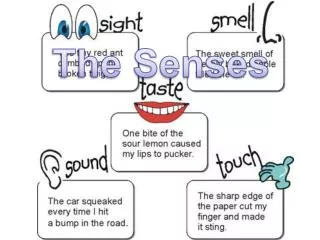
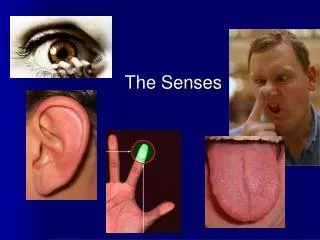
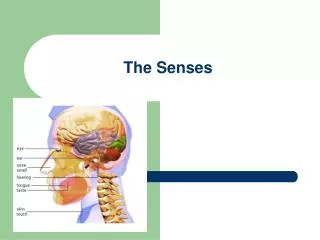
The Senses • The senses provide us with information about our surroundings, and allows us to respond appropriately. • Includes: sight, hearing, touch, taste, smell, equilibrium.
Sensory pathway • Receptors: detect stimuli (changes) and generate the impulse. • Neurons: transmit the impulse to the CNS • Sensory Tracts: the spinal cord or brain that transmits the impulses • Sensory Area; most in the cerebral cortex. Feel the sensation.
Cutaneous Senses • The dermis of the skin has receptors that sense touch, pressure, heat, cold and pain
Muscle sense • Also called kinesthetic. Allows brain to detect where muscles are and how positioned.
Sense of taste • Receptors for taste are taste buds. • These are Chemoreceptors. There are 4 main ones • Sweet, sour, salty, and bitter. • Many medications, drugs and smoking interfere with the taste, and may lead to poor nutrition.
Sense of smell • Also from chemoreceptorsthat detect vaporized chemicals. • A lot of what we call taste is actually the smell of food instead.
Hunger and Thirst • Internally triggered by receptors in the hypothalamus. They detect nutrient and chemical levels and the water-salt concentration.
The Eye • Has receptors for vision and focusing light rays • Has 3 layers: • 1. Schlera: thickest layer of fibrous connective tissue and is the visible white part • Cornea: most anterior portion. It is transparent. This is the first part that bends light
2. Choroid layer: contains blood vessels and a blue pigment to absorb light. • Lens: transparent. Shape is changed to allow eye to focus light from varying distances. • Iris: colored part of eye • Pupil: central opening
3. Retina: • Posterior part of eye. Contains all visual receptors, the rods, and cones. • Rods: detect presence of light • Cones: detect colors (absence of cones causes colorblindness) • In order to see, light rays must be focused on the retina and the nerve impulses transmitted to the visual area of the cerebral cortex.
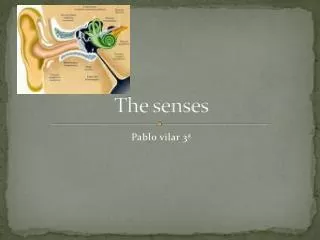
The Ear • The ear consists of 3 areas: • The outer ear • The middle ear • The inner ear • The ear contains receptor for 2 senses • Hearing • Equilibrium