Download
1 / 9
90 likes | 204 Vues
This overview explores the intricate energy flow within ecosystems, highlighting the essential processes of photosynthesis and cellular respiration. It elucidates the roles of producers (autotrophs) in capturing solar energy and converting it into carbohydrates, which serve as food for consumers (heterotrophs). The discussion extends to food chains and webs, illustrating how energy is transferred among organisms and the significance of trophic levels. Key concepts such as energy loss at higher trophic levels are examined, underscoring their impact on ecosystem structure and biodiversity.

E N D
Section 2:Energy Flow in Ecosystems Alec Haase, Brandon Geddis, Aalia Khan, and Travis Reed
Life Depends on the Sun • Photosynthesis: The process by which plants, algae and some bacteria use sunlight, carbon dioxide and water to produce carbohydrates and oxygen • Energy from the sun enters ecosystems when plants use sunlight to make sugar molecules
Producers • An organism that can make their own food are called producers, autotrophs, or self-feeders • Plants are all considered producers
Consumers • An organism that get their energy by eating other organisms are called consumers • Consumers are also called heterotrophs or other-feeders
Cellular Respiration • The process by which cells produce energy from the carbohydrates; atmospheric oxygen combines with glucose to form water and carbon dioxide. • Also known as the process by which cells break down food to yield energy • An organism obtains energy from the food it eats • Food must be broken down within its own body • During cellular respiration, cells absorb oxygen and use it to release energy from food. • Through cellular respiration, cells use glucose (sugar) and oxygen to produce carbon dioxide, water, and energy.
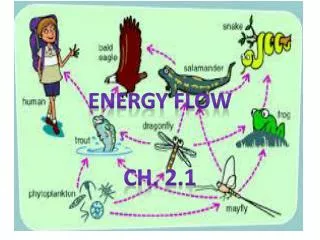
Food Chains and Food Webs • A food web shows how many feeding relationships that are possible in an ecosystem. • Ecosystems almost always have more than one food web. • A food chain is a sequence in which energy is transferred from one organism to the next as each organism eats another. • Each time an organism consumes another an energy transfer occurs.
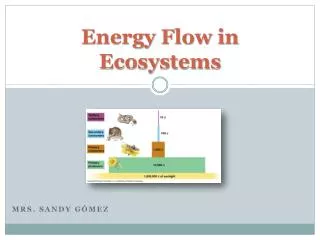
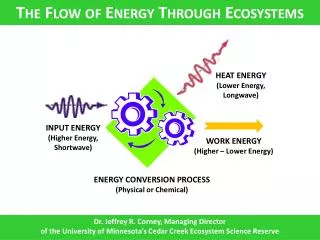
Trophic Levels • Each time energy is transfer , some of the energy is lost as heat. • Therefore, less energy is available to organisms at higher trophic levels. • One way to visualize it is with an energy pyramid.
Energy Loss affects Ecosystems • Decreasing amounts of energy at each trophic level affects the organization of an ecosystem. • Energy loss affects the number of organism at each level • Energy loss limits the number of trophic levels in an ecosystem.
Video • http://www.youtube.com/watch?v=NVd9Ch44s_Y