Download
1 / 17
180 likes | 297 Vues
This overview covers essential concepts in cell reproduction, focusing on chromosomes and their structure during cell division. It explains how DNA condenses to form chromosomes in eukaryotic cells, the role of histones and non-histone proteins, and the significance of various chromosome types such as autosomes and sex chromosomes. It also details the processes of mitosis and meiosis, including the formation of gametes and the implications of genetic variation through independent assortment and crossing over.

E N D
Cell Reproduction 8.1 Chromosomes 8.2 Cell Division 8.3 Meiosis
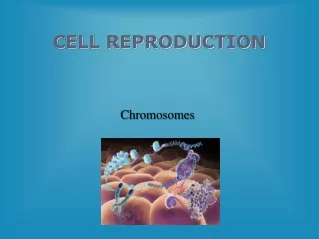
Chromosome Structure • During cell division DNA condenses to form chromosomes. • Eukaryotic cells DNA wraps around histones • Activity of specifc regions controlled by nonhistone proteins
Chromatid • Centromere • Tetrad
Chromatid • Centromere
Chromosomes Numbers • Sex chromosomes • Autosomes • Homologous chromosomes • Karyotype • Diploid cells • Body cells • Haploid cells • Sex cells (gametes)_ Click
Cell Division Prokaryotes • Binary Fission
Eukaryotes • Mitosis
The cell cycle • Interphase • Mitosis • Cytokinesis
Meiosis • Produces 4 haploid gametes • Egg (n) • Sperm (n) • Fusion of egg & sperm results in zygote (2n)_
Meiosis I • Synapsis occurs forming a tetrad • Prophase I, crossing over can occur. • genetic recombination. • Independent assortment • genetic variation.
Meiosis II Results in 4 new cells, each with single set (n) of chromosomes.
Formation of Gametes • In reproductive organs • Testes • Ovaries • Spermatogenesis • Spermatids • Oogenesis • 1 egg cell • 3 polar bodies
The cell cycle • Interphase • Mitosis • Cytokinesis