Download
1 / 24
240 likes | 336 Vues
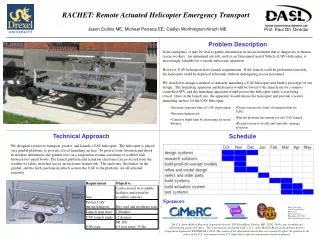
The MEM Senior Design Team Number 10 developed a system for safely transporting and deploying an unmanned helicopter to hazardous sites, aiming to support rescue efforts efficiently. The system includes a suspension trailer, leveling gimbal, and enclosure framework. Key components ensure the UAV's stability, protection, and effective operation. The project addresses technical requirements while optimizing for remote control and monitoring. Proposed solutions for the leveling and dampening systems enhance performance, providing a reliable and adaptable solution for UAV transportation.

E N D
System to Remotely Transport and Deploy an Unmanned Helicopter MEM Senior Design Team Number 10 Dr. Paul Y. Oh (Advisor) Jason Collins (MEM) Michael Perreca (ECE) Caitlyn Worthington-Kirsch (MEM) Drexel Autonomous Systems Laboratory (D.A.S.L.) December 5, 2007
Overview -Hazardous site rescue effort -UAV provide observational platform during “Golden Hour” -Not interfere with existing rescue efforts -Rapid unmanned transport and deployment -Adapt to dynamic situation -Current mission plan gap: Unmanned transport and deployment of UAV systems Goal: Design trailer to carry UAV to scene http://newsimg.bbc.co.uk/media/images/44194000/jpg/_44194534_afp203bodybonita.jpg http://www.viewimages.com/Search.aspx?mid=51919023&epmid=1&partner=Google
Thresholds and Objectives
System Overview Enclosure framework Suspension Trailer Leveling gimbal
Design Parameters Leveling System -keep UAV level as trailer pitches and rolls -prevent UAV from hitting any part of trailer and support system -hold UAV in place during transit -release UAV for launch -hold platform in place for launch Suspension System -protect UAV from ground vibration -protect UAV from sideways and twisting motion
Design Parameters Trailer Base and Enclosure -fit through double doors (60") -protect UAV from debris and weather -use a standard trailer hitch -towable by 90 cc displacement ATV -fit inside a cargo van for long-distance transportation Actuator Electronics System -remotely actuate and monitor system electronics
Technical Requirements Leveling System:Level UAV platform to within +/- 2 degreesLock platform angle during takeoff Suspension System:Support approximately 100 lbsReduce vibration at 5HzReduce vibration by at least 90% Trailer/Enclosure:Maximum width 60”Shed minimum of 4mm/hr of rain Data Acquisition System:14 I/O PortsRemote range of 300ft
Leveling System Proposed Solution -Gimbal system to level platform -Breaks to dampen oscillation -Bump stops to prevent over travel
Dampening System Design Initial design: a classic spring-dashpot system Only moves along one axis Bowls made the ball design stable and adaptable A compressible sphere moves on all axes and is simple, but still unstable Allowing sideways movement - unstable Multiple systems for different axes – too complex
Dampening System Proposed Solution Compressible ball between two bowls Allows for sideways and twisting movement Transference of approximately 5% of vibration at 5 Hz Tunable for varying conditions by inflating and deflating ball Proof-of-concept Cad model
Data Acquisition andActuation ElectronicsPossible Solution Electronics QFD
Data Acquisition andActuation ElectronicsProposed Solution National Instruments Compact RIO • On-board data manipulation • Expandable through the use of NI C-Series Modules • 50 g shock rating • Temperature rating between -40 and 158 °F - Proven to process analog signals by the proof of concept • - Readily available from D.A.S.L. NI Compact RIO
Trailer and Enclosure Possible Solutions Option 1: 56” x 55” Deck over trailer Option 2:56” x 7'6” Deck over trailer Option 3:56” x 7'6” Deck over with box enclosure already installed Option 4:Custom built trailer by Senior Design Group Trailer/Enclosure QFD
Timeline Jan 14 – Design Freeze Jan 21 – all parts sourced and ordered Jan 28 – Begin building trailer, testing components as they are built Feb 11 – Gimbal built Feb 18 – Vibration control system built Feb 25 – Enclosure built Mar 10 – Full trailer testing begins May 5 – Final report and end of project
Projected Market Projected production price: $5,000 per unit Helicopter price: $40,000 per unit UAV transportation is a common problem in the field Over 80 companies are developing different UAVs, and over 5,000 UAVs are in use today* As UAVs gain popularity, producing a reliable means of off-road transportation is a viable profit source. *http://www.uavforum.com/library/librarian.htm
Budget Total project expenses, including salaries: $105,000 Total project expenses, excluding salaries: $10888 Actual expenditure: approx. $3000 Options represent high-end, mid-range, and low-end prototypes Options in: Frame and gimbal materials Enclosure material Trailer base
Deliverables • Leveling system • -Data Acquisition and Actuation Electronics -Suspension system -Enclosed Trailer -Testing Results -Final Design Report
Acknowledgements Dr. Paul Y. Oh D.A.S.L. Members MEM Senior Design Committee ECE Senior Design Committee All Those in Attendance
Thank You Questions? ?