Muscular System
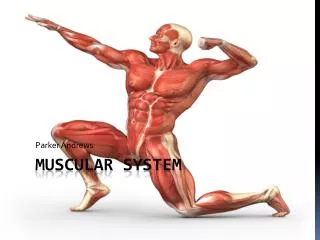
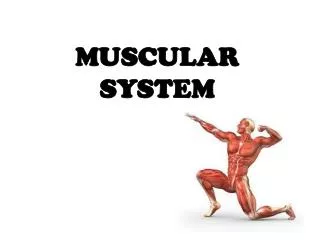
Learn about the three types of muscles - skeletal, cardiac, smooth - their structure, function, and mechanism of contraction. Dive into muscle structure and the molecular basis of muscle contraction. Discover how muscles work together and types of skeletal muscle fibers.

Muscular System
E N D
Presentation Transcript
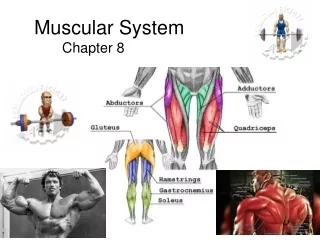
Muscular System Chapter 8
Learn your muscles Poke a Muscle
The 3 Muscle Types • The job of all muscles is to contract • They are all fibrous because cells are elongated • The 3 Muscle Types Are: • Skeletal Muscle • Cardiac Muscle • Smooth Muscle Overview Of Muscle
Skeletal Muscle • Cigar Shaped • Multinucleated • Striated • Voluntary • Can Be Involuntary When Reflexes Are Involved • Very Strong and Fast But Need Rest • Most Attached to Bone • Do not undergo mitosis. Once dead, dead.
Smooth Muscle Long thin nuclei and no striations
How are Muscles Structured? • Muscle Cells have a plasma membrane called a Sarcolemma. • The muscle fiber is enclosed in Endomysieum. (Endo= , Mys= ) • Many Muscle fibers bound together make a Fascicle. • The Fascicle is wrapped in a membrane called the Perimysieum (Peri= ). Pg. 174 Tortora
Muscle Structure Continued • Many fascicles are wrapped together by an Epimysium. (Epi= ) • Epimysia attach to tendons or Aponeuroses. (pg. 192: Tortora) • Tendons: Strong, Thin, and made up of collagen (dense connective tissue). Aponeuroses are sheet-like tendons.
Skeletal Muscle (pg. 174) Quiz Yourself
What is the major Organelle of the Muscle Cell? Pg. 176 • Myofibril(s)=Working unit of the muscle cell. Made of Subunits called sarcomeres. • Give muscles the striped or striated appearance • The light band is the I-band • The dark band is the A-band • Between the I-bands is the Z-line • Between the A-bands is the H-zone Match the Terms
Mechanism of muscle contraction • The above micrographs show that the sarcomere gets shorter when the muscle contracts • The light (I) bands become shorter • The dark bands (A) bands stay the same length
Take a long deep breath, its not that bad. • And remember a bicycle cannot stand alone, because it is two tired. • Now lets go on. • But lets first watch this short video clip. Overview of the Job of the Bands
So how do these bands work? • The myofibrils are surrounded by the sarcoplasmic reticulum, a specialized form of smooth endoplasmic reticulum that releases calcium. • They are made of bands of • Actin (the thin filaments) that make up the I-bands • Myosin (the thick filaments) that make up the A-bands
So what is the Molecular Basis of Muscle Contraction? (pg. 176) • 1) Nerve sends out Acetylcholine or ACh • 2) Motor Unit= All muscles triggered by nerve. (1 nerveTriggers 100’s of cells) • 3) The Sarcolema becomes permeable to Na+ • 4) Na+ causes an action potentialbecause it disturbs the electrical conditions of the sarcolema (pg.178)
How does ACh stimulate the muscle? • ACh causes the sarcolema to release Calcium (Ca+) • Ca+ binds to the actin causing it to change shape. • Myosine finds actin’s new shape attractive and grabs hold.
What happens after the Myosin grabs hold? (pg. 179) • Myosin’s head snaps towards the H-band of the sarcomere. • ATP releases and re-cocks the myosin • Only some myosin heads move at one time. • Over all: Pg. 181 Description of Muscle movement
How does the muscle relax? • When the action potential ends: • Sarcomere absorb Ca+ • ATP releases myosin heads • Actin takes on its former and less attractive shape. • Muscle Cells can relax Best Movie on Muscle Contraction Revisited Best Movie review of the muscle
Write one paragraph explaining how a muscle works. Do this from memory. This will help you learn. Paul Anderson Review
So, What is this Action Potential? • Action Potential • Electrical Current or Charge • In order to return the cell to its original condition, K+ is pumped into the cell by the sodium potassium pump. Sodium/ Potassium Pump
How do muscles work together? How do Muscles work Together? • Prime Mover: Major muscle doing the bulk of the work contracting. • Synergist: Group of muscles working together to contract. • Antagonist: Muscle that works against the prime mover and or synergists.
Summation and Tetanus • Twitch: a single action potential causing the muscle to contract for a millisecond and then relax. Latent...Contraction...Relaxation period • Summation effect: a second action potential arrives before the first is over. The contraction is larger. Wave summation • Tetanus: multiple summation effects causing a smooth sustained contraction. • Fatigue will set in and forces relaxation.
What is Recruitment? • Motor unit recruitment: various motor neurons in a whole muscle do not fire at the same time. Some are relaxed some are contracted. • Why? • Creates smooth muscle units not jerky movements. • Put your hand out and hold it still…..
Types of Skeletal Muscle Fibers • Slow…Slow Oxidative Fibers (SO) • Red, Make ATP Aerobiclatly, Fatigue resistant. Marathon runners getting out of a chair when old. • Fast • Fast oxidative –glycolytic Fibers (FOG). • Red, ATP by anaerobic Medium fast • Fast glycolytic Fibers (FG) • White. Anaerobic. Short, Fast, circuit trainers
Why can you crack your joints? Click here to find out!
Muscle Movements • http://www.healthchecksystems.com/exercise1.htm#hyper
Types of Muscle Movements Flexion: decrease in the angle between articulating bones. Extension: increase in the angle between articulating bones.
Abduction: movement of bone away from the midline Adduction: movement of bone towards from the midline
To exercise the: Quadriceps: straighten the knee
To exercise the: Hamstring Group Bend the knee. Flexes thigh. Includes the bicepts femoris
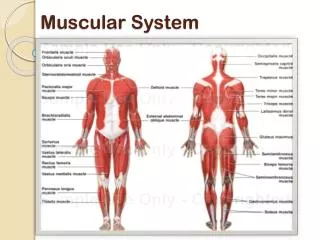
Exercise the: Trapezius : rotates shoulder., shoulder shrugs. Extends head.
Exercise for: Latissimus Dorsi: moves arm down and backwards.
Exercise for: Deltoid: abducts, flexes, extends & rotates arm at shoulder joint.
Exercise For: Gluteus Maximus extends and rotates thigh laterally at hip joint.
Exercises for: Oblique: Flexes vertebral column, contracts sides, rotates.
Exercises for: Rectus Abdominis: flexes vertebral column / compresses abdomen (think crunches)
Exercise for : Pectoralis Major Adducts and rotates arm medially. Extends arm at shoulder Push up: Works Pecs on The Up-Motion
Exercises for: Bicep contracts arm into L shape
Exercises for: Triceps …extends arm at shoulder and elbow
Now Quiz Yourself! See if you know your muscles… Another good Quiz site
Interesting Aspects: • Some of us may have a spare muscle: the Plantaris muscle 1 in 10 don’t. • Want to see it? Click the link. • Groin pull? Here is the problem: Plantaris In Action Groin Pull Or strain.