
SlideServe
Menu
Préférences
© SlideServe · v2026

Maximizing Profits in Train Scheduling Optimization

vparks avatar
19 diapositives · 231 Views · Dec 19, 2019

Optimize train schedules to maximize profits by efficiently assigning ideal departure and arrival times, considering train types, shifts, and stretches.
Maximizing Profits in Train Scheduling Optimization - slide 1
1 / 19

Télécharger la présentation

Maximizing Profits in Train Scheduling Optimization
Une image / un lien ci-dessous est fourni (tel quel) pour télécharger la présentation

Politique de téléchargement : le contenu du site vous est fourni TEL QUEL pour votre information et votre usage personnel ; il ne peut être vendu, concédé sous licence ni partagé sur d’autres sites sans l’accord de son auteur.Le contenu vous est fourni TEL QUEL, pour votre information et votre usage personnel uniquement. Téléchargez la présentation en cliquant sur ce lien. Lors du téléchargement, si vous ne parvenez pas à télécharger une présentation, l’éditeur a peut-être supprimé le fichier de son serveur.Pendant le téléchargement, si vous ne parvenez pas à obtenir une présentation, le fichier a peut-être été supprimé par l’éditeur.

F I N

Plus de contenu associé

Transcription de la présentation
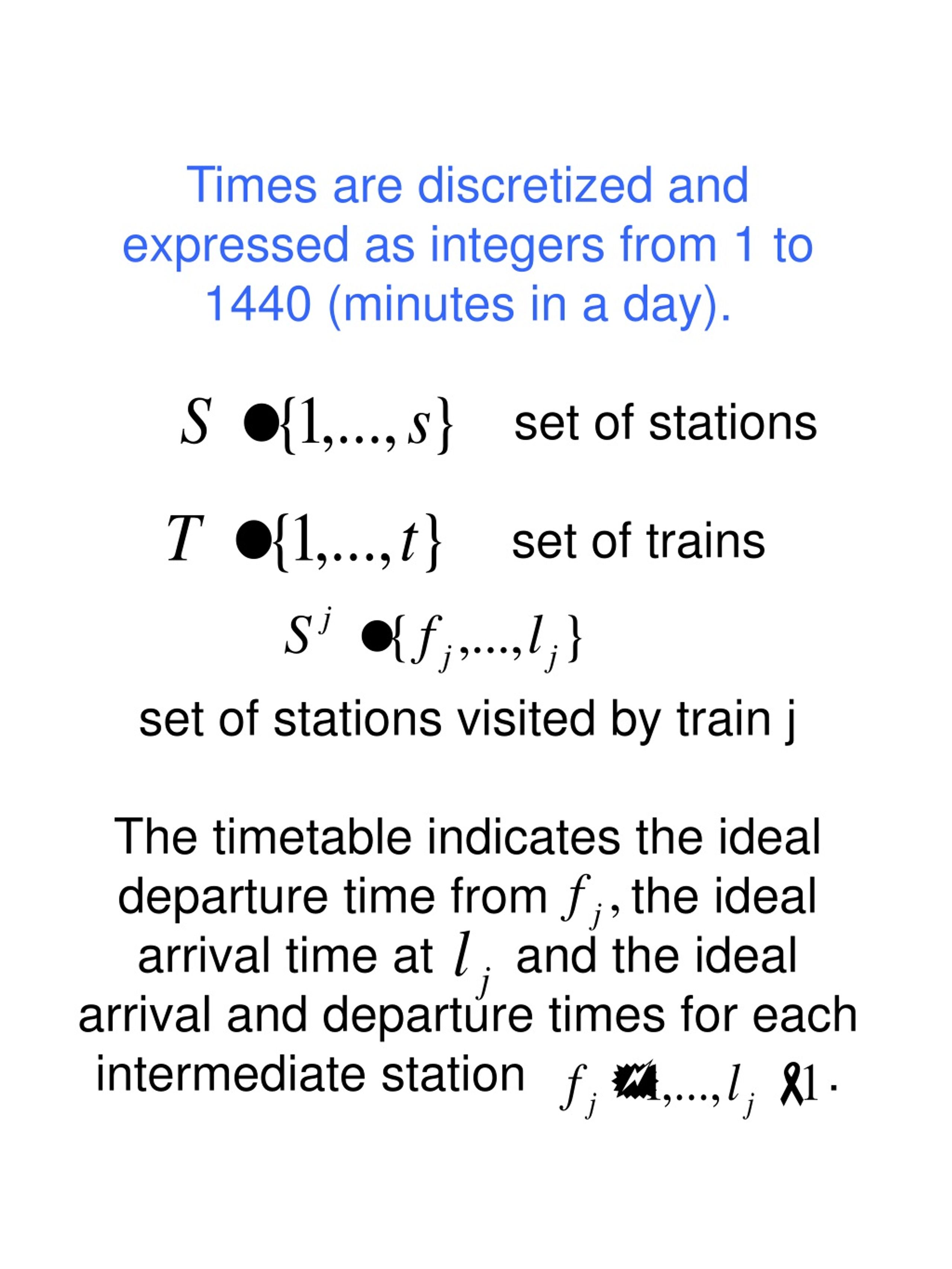
  1. Times are discretized and expressed as integers from 1 to 1440 (minutes in a day). set of stations set of trainsset of stations visited by train jThe timetable indicates the ideal departure time from the ideal arrival time at and the ideal arrival and departure times for each intermediate station .

  2. Each train j is also assigned an ideal profit depending on the type of the train (eurostar, freight, etc). If the train is shifted and/or stretched the profit is decreased. If the profit becomes null or negative the train is cancelled.The objective is to maximize the overall profit of the (scheduled) trains. shift stretch (i.e. sum of the stretches in all stations)

  3. A graph formulation(Time-Space Graph)G=(V,A) directed acyclic graphV set of nodes:A set of arcs: Arrival nodes at station i Departure nodes from station i Two types of arcs: Segment arcs Station arcs

  4. Train j station dep_node_1 segment_arc_1 arr_node_2 station_arc_2 dep_node_2 segment_arc_2 arr_node_3 station_arc_3 dep_node_3 segment_arc_3 arr_node_4 time

  5. Departure Constraints: dep_1 dep_2 stat 1 stat 2 Arrival Constraints: stat 1 stat 2 arr_1 arr_2 Overtaking Constraints: stat 1 stat 2

  6. “Feasible” path from to Timetable for train j using arcs in Set of “feasible” paths, at most one path for each train. Overall timetable

  7. notation Set of nodes belonging to train j Set of departure nodes from station i Set of arrival nodes to station i Set of feasible paths for train Set of feasible paths for all the trains Actual profit for path Set of paths that visit node u, Set of paths belonging to train j, that visit node u

  8. For each train Profit of a path = profit of arc a: for the first arc leaving corresponding to shift for the segment arcs for station arcs corresponding to stretch

  9. MODEL B Set of feasible paths for train Set of feasible paths for all the trains We introduce a binary variable for each feasible path for a train. path p in the solution otherwise

  10. Solution method:branch-and-cut-and-priceconstructive heuristics

  11. The solution method uses the LP-relaxation for:obtaining an upper bound on the optimum solution value suggesting good choices in the construction of the solution.

  12. LP-relaxationis solved using column generationandconstraint separationas the number of variables and constraints is huge for real-world instances.

  13. Column generationAdd variables with positive reduced profits. Reduced profit of path p in Sum of dual variables of constraints involving node For each train, find the maximum profit path in an acyclic graph.

  14. Constraint separationAdd constraints violated by the current solution.departure/arrival constraintsovertaking constraints

  15. Departure/arrival constraint separationFor each station, sum the values of the variables corresponding to paths that visit nodes in each window smaller than minimum time interval between 2 departures (analogously for arrivals). minimum time interval between 2 departures

  16. Overtaking constraint separation(overtaking between 2 trains j,k) For each for each and let : analogous sum the values of the variables of train j in the window: sum the values of the variables of train k in the window:

  17. Overtaking constraint separation(overtaking among 2 or more trains) Exact method (dynamic programming). Order paths by decreasing speed. Clique: set of incompatible paths. Status: b,c.