The Age of Exploration: European Expansion and Asian Isolation (1400-1800)
The period between 1400 and 1800 marks a significant era of exploration driven by European nations seeking wealth, land, and the spread of Christianity. Key players like Portugal and Spain initiated sea routes to Asia, while early Ming emperors in China strengthened their empire. During the Tokugawa Shogunate, Japan experienced a flourishing culture but eventually opted for isolation from Western influences. This chapter explores the motivations for exploration, the establishment of trading empires, the successes of the Ming Dynasty, and Japan's complex interactions with European powers.

The Age of Exploration: European Expansion and Asian Isolation (1400-1800)
E N D
Presentation Transcript
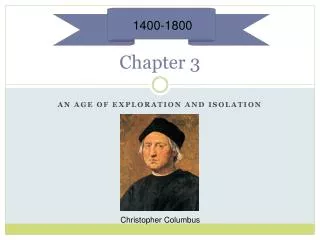
Chapter 3 1400-1800 AN AGE OF EXPLORATION AND ISOLATION Christopher Columbus
Chapter Objectives • Identify the factors that led to European exploration • Describe how Portugal established a sea route to Asia and why • Identify which nations set up trading empires in the East and where those nations dominated • Identify the successes of early Ming emperors in China • Describe Japanese society and culture during the Tokugawa Shogunate • Explain how Japan’s policies toward Europeans changed
Section 1: Europeans Explore the East • Driven by the desire for wealth, land, and Christian converts, Europeans began an age of exploration • The Renaissance had encouraged a new spirit of adventure and curiosity • 1400 was not first time for exploration • 1100- Crusaders fight Muslims for Holy Lands in Southwest Asia • 1275- Marco Polo reached China
“God, Glory, and Gold!” • Reasons for the Exploration 1. Seek greater wealth 2. Spread Christianity 3. Technological advances • Portugal led these sailing innovations • Prince Henry- founded navigation school with mapmakers, instrument makers, shipbuilders, scientists, and sea captains • Started sailing down coast of Western Africa; set up trade ports • Wanted to find sea route to Asia
In order to reach Asia, had to sail around southern tip of Africa • 1487- Bartolomeu Dias- 1st to round tip; battered by storm so returned home • 1498- Vasco da Gama- reached port of Calicut in India; returned with spices and silk; gave Portugal direct route to India • 1492- Spanish jealous so sent Christopher Columbus west to find a route to Asia across the Atlantic; landed on an island in the Caribbean • Increased tension between Spain and Portugal led to Treaty of Tordesillas and Line of Demarcation
Struggle for Dominance 1500-1700s • England • France • Netherlands • Portugal • Spain • Each country created an East India Company • Wanted control of trade routes and therefore the goods and money that came with it
Section 2: China Rejects European Outreach • Ming Dynasty 1368-1644 • Hongwu- drove Mongols out of China in 1368 • Became 1st Emperor of Ming Dynasty • Reformed agriculture, erased traces of Mongol past, increaed China’s power and prosperity, increased rice production, improved irrigation, encouraged fish farming and the growth of cotton and sugar cane • Return to Confucian moral standards; merit-based civil service • Yonglo- 1398- Hongwu’s son came to power; moved royal court to Beijing and launched Chinese explorers
Zheng He- led Chinese explorations • Voyaged to Southeast Asia and India, Arabia, and eastern Africa • Increased China’s tribute system • 1433- China withdrew to isolation • China’s official trade policies reflected isolation • Only government could conduct foreign trade through 3 ports • Kept taxes low on agriculture but high on manufacturing and trade • As a result, merchants turned to smuggling to keep up with demand for Chinese silk and porcelain
Qing Dynasty 1644 • Manchus from Manchuria invaded China; took over Beijing • Kangxi- 1661-1736 1st Emperor; reduced gov’t expenses; lowered taxes; favored arts and intellectuals • Qian-long- 1736-1795; brought China to it’s greatest size and prosperity; allowed Dutch traders but they had to pay tribute; Dutch took tea to the rest of the world • Population doubled to more than 300 million in 1800
Section 3: Japan limits Western Contacts • In 1300s, the unity that Japan had achieved started to slip away because of fighting between shoguns • 1467- civil war broke out and centralized rule ended; power slipped away from the shogun to territorial lords in hundreds of separate domains • 1600- Tokugawa Ieyasu defeated rivals and became sole ruler • Unified Japan until 1867
Tokugawa Society • Led to stability, prosperity, and isolation • Merchant classes flourished; rise of commercial centers • Culture also flourished- theatre (kabuki), poetry (haiku) • At first, welcomed outside merchants (Portuguese); interest in new technology and ideas (guns, clocks, tobacco) • Firearms (guns, cannons) changed Japan forever; had always used swords • Christian missionaries= spread the religions
Closing off the Country • Tokugawa Ieyasu found aspects of Christian religion troubling- thought it led to revolts; persecuted Christian converts and made everyone demonstrate faithfulness to Buddhism • 1639- closed Japan’s borders from merchants and missionaries • Exception- Nagasaki open to Dutch and Chinese merchants • For more than 200 years, Japan remained basically closed to Europeans and continued to develop as a self-sufficient country