Understanding RNA
This guide explores Ribonucleic Acid (RNA), its structure composed of ribose sugar, phosphate groups, and nitrogen bases like adenine, uracil, cytosine, and guanine. It delves into RNA's critical role in protein synthesis, detailing the processes of transcription (copying DNA into mRNA) and translation (assembling amino acids into proteins). The differences between RNA and DNA are highlighted, along with the three main types of RNA: messenger RNA (mRNA), transfer RNA (tRNA), and ribosomal RNA (rRNA). Discover how RNA facilitates the flow of genetic information essential for life.

Understanding RNA
E N D
Presentation Transcript
Understanding RNA Ribonucleic Acid
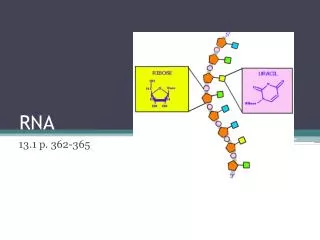
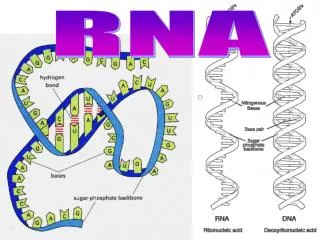
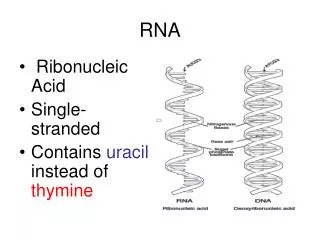
A. Sugar (ribose) B. Phosphate Group 1. Made of Nucleotides: C. Nitrogen Bases B A C
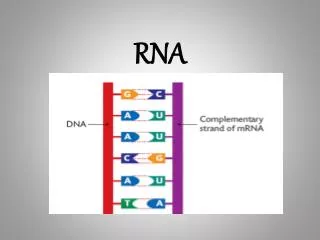
A. Cytosine Guanine (C G) B. Adenine Uracil (A U) Notice that RNA has Uracil (not thymine) 2. Rules for Base Pairing:
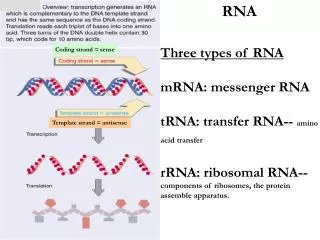
3. What is the function of RNA? * helps to make protein 4. Types of RNA A. Messenger (mRNA) B. Transfer (tRNA) C. Ribosomal (rRNA)
Nitrogen Base Sugar (ribose) Phosphate Group
√ √ √ √ Comparing DNA & RNA √ √
√ √ Comparing DNA & RNA √ √ √
√ √ Comparing DNA & RNA √ √ √
√ Comparing DNA & RNA
Protein Synthesis: How Proteins are Made
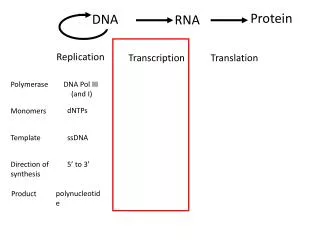
Step 1: Transcription– making a mRNA copy of DNA; occurs in the nucleus
Why Transcription? Don’t Write This Slide, Just Read!!! • DNA contains volumes of information about making protein. • Unfortunately, DNA is too huge to leave the nucleus but the protein is made in the ribosomes.
The DNA molecule unzips at the nitrogen bases • mRNA nucleotides pair up with DNA nucleotides (one side) Summary of Transcription
Summary of Transcription C. DNA “rezips” and mRNA leaves the nucleus Click Here for Transcription Animation
Step 2: Translation – amino acids are being assembled into proteins; occurs in the ribosomes
B. 3 mRNA nucleotides (codons) pair up with 3 tRNA nucleotides (anticodons) C. amino acids are added until the “stop” message is reached Summary of Translation A. mRNA enters the ribosome
* 1 codon makes 1 amino acid; 3 nitrogen bases makes 1 amino acid * Codon – three mRNA bases * Anticodon – three tRNA bases
Example: DNA: DNA: TAC – AGG – GGT - ACG – CCG – AAT – GGG – ATT – AUG – UCC – CCA – UGC – GGC – UUA – CCC – UAA - mRNA: tRNA: Amino Acid:
Example: DNA: GCA – AAT- TTA mRNA: CGU – UUA - AAU tRNA: Amino Acid:
Example: DNA: TAC – AGG – GGT - ACG – CCG – AAT – GGG – ATT – mRNA: AUG – UCC – CCA – UGC – GGC – UUA – CCC – UAA - UAC – AGG – GGU – ACG – CCG – AAU – GGG – AUU - tRNA: Amino Acid:
Example: DNA: GCA – AAT- TTA mRNA: CGU – UUA - AAU tRNA: GCA – AAU - UUA Amino Acid:
Write this on the bottom of your “Chart of Amino Acids”: Use mRNA to find the Amino Acid on the Chart
U C A G U Phenylalanine Phenylalanine Leucine Leucine Serine Serine Serine Serine Tyrosine Tyrosine Stop Stop Cysteine Cysteine Stop Tryptophan U C A G Second mRNA Base C Leucine Leucine Leucine Leucine Proline Proline Proline Proline Histidine Histidine Glutamine Glutamine Arginine Arginine Arginine Arginine UCAG First mRNA Base Third mRNA Base A Isoleucine Isoleucine Isoleucine Methionine Threonine Threonine Threonine Threonine Asparagine Asparagine Lysine Lysine Serine Serine Arginine Arginine UCAG G Valine Valine Valine Valine Alanine Alanine Alanine Alanine Aspartic Acid Aspartic Acid Glutamic Acid Glutamic Acid Glycine Glycine Glycine Glycine UCAG
Amino Acid: Example: DNA: TAC – AGG – GGT - ACG – CCG – AAT – GGG – ATT – mRNA: AUG – UCC – CCA – UGC – GGC – UUA – CCC – UAA - tRNA:UAC – AGG – GGU – ACG – CCG – AAU – GGG – AUU - - STOP – Pro Met – Gly – Leu – Ser – Cys – Pro
Anticodon Codon