

SlideServe
Menu
Préférences
© SlideServe · v2026

Jerome Bruner

waite avatar
13 diapositives · 1.4K Views · Jul 23, 2014

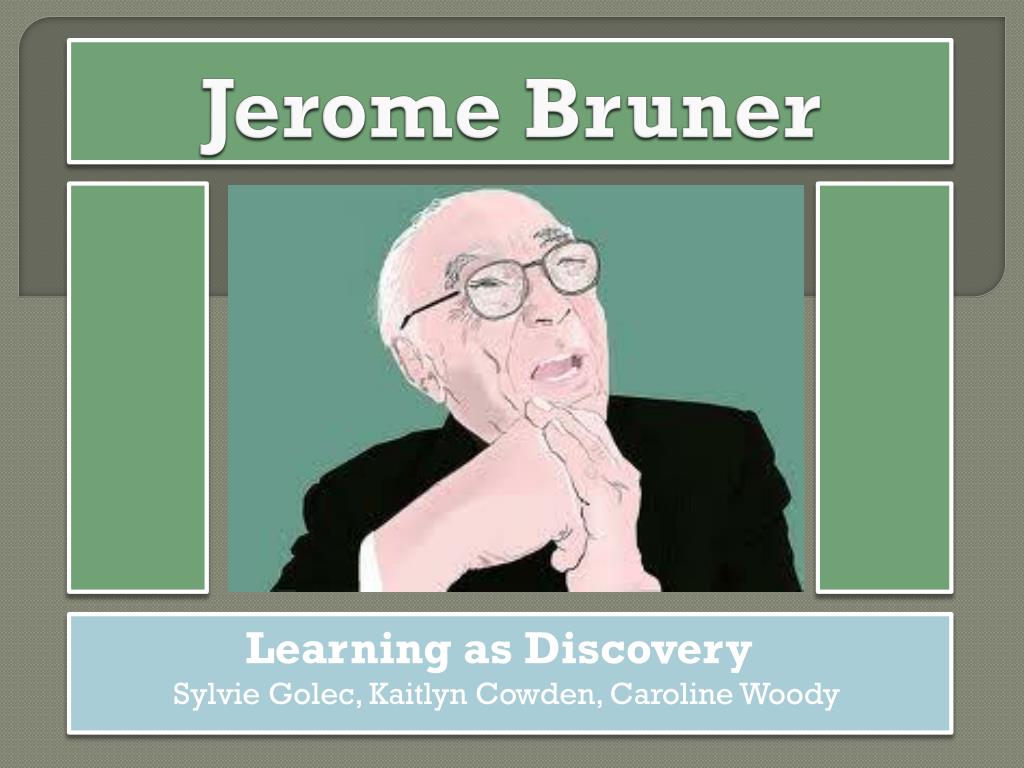
Jerome Bruner. Learning as Discovery Sylvie Golec, Kaitlyn Cowden, Caroline Woody. Who is Jerome Bruner?. American Psychologist Born in New York, 1915 Studied Psychology at Duke University Earned his doctorate in Psychology from Harvard Taught as a professor at Harvard, Oxford and NYU.
Jerome Bruner - slide 1
01 / 13Jerome Bruner
1 / 17

Télécharger la présentation

Jerome Bruner
Une image / un lien ci-dessous est fourni (tel quel) pour télécharger la présentation

Politique de téléchargement : le contenu du site vous est fourni TEL QUEL pour votre information et votre usage personnel ; il ne peut être vendu, concédé sous licence ni partagé sur d’autres sites sans l’accord de son auteur.Le contenu vous est fourni TEL QUEL, pour votre information et votre usage personnel uniquement. Téléchargez la présentation en cliquant sur ce lien. Lors du téléchargement, si vous ne parvenez pas à télécharger une présentation, l’éditeur a peut-être supprimé le fichier de son serveur.Pendant le téléchargement, si vous ne parvenez pas à obtenir une présentation, le fichier a peut-être été supprimé par l’éditeur.

F I N

Plus de contenu associé

Transcription de la présentation
  1. Jerome Bruner Learning as Discovery Sylvie Golec, Kaitlyn Cowden, Caroline Woody

  2. Who is Jerome Bruner? American Psychologist Born in New York, 1915 Studied Psychology at Duke University Earned his doctorate in Psychology from Harvard Taught as a professor at Harvard, Oxford and NYU

  3. Contributions to Psychology A pioneer of the cognitive psychology movement Studied how children learn Coined the term “scaffolding” Described learning as active, not passive. Described children's development in 3 stages: enactive stage, iconic stage, and symbolic stage Helped found the Center of Cognitive Studies at Harvard.

  4. Children’s Cognitive Development Enactive Stage (0-3): Children only perceive environment through own actions Iconic Stage (3-8): Visual memory increases Symbolic Stage (8-on): Children begin to use symbols

  5. Learning as Discovery • Constructivism • Exploration and manipulation • Inquiry-based instruction • Discovering facts from • Past experience • Existing knowledge • New truths • Relationships

  6. Advantages to Bruner’s Theory • Encourages active engagement • Promotes • A tailored learning experience • Motivation • Autonomy • Responsibility • Independence • The development of creativity and problem solving skills.

  7. Related to Education • Examples • Enactive stage • Learning through motor skills • Iconic stage • Accommodating visual learners through icon imagery • Symbolic stage • Pictures and symbols to represent a whole

  8. Enactive Stage

  9. Iconic Stage

  10. Symbolic Stage

  11. Discovery Education http://www.discoveryeducation.com/ Resources for school administrators, teachers, parents, and students Covers K-5, 6-8, and 9-12 Subjects include: Math, Science, English, Social Studies, Health, World Languages, Technology Resources include: lesson plans, virtual field trips, live webinars, homework help, and more

  12. Webquests  http://webquest.org/ Uses the internet to help guide students' learning 6 parts: introduction, task, process, resources, evaluation, conclusion Teachers can create their own or select from a variety available on the web Useful for introducing or concluding a unit Example "What's it like to visit Italy?" http://questgarden.com/100/69/8/100410120623/index.htm

  13. Resources http://www.infed.org/thinkers/bruner.htm http://webquest.org/ http://questgarden.com/100/69/8/100410120623/index.htm http://www.discoveryeducation.com/ http://www.simplypsychology.org/bruner.html http://www.learning-theories.com/discovery-learning-bruner.html