Understanding Stars: Types, Composition, and Celestial Structures
This study guide provides essential answers to fundamental questions about stars and galaxies. It covers the unique differences between stars, lists star types from smallest to biggest, and explains the concept of a light year, including its significance. The guide explores the composition of stars, their emissions, and the color spectrum from hottest to coldest stars. Additionally, it addresses galaxies, their shapes, the use of spectrographs, and explains luminosity, gravitational effects on celestial shapes, and the formation of nebulas. Organize your answers to enhance your understanding of astronomy.

Understanding Stars: Types, Composition, and Celestial Structures
E N D
Presentation Transcript
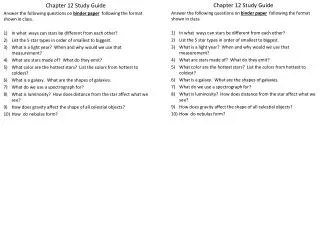
Chapter 12 Study Guide Answer the following questions on binder paperfollowing the format shown in class. • In what ways can stars be different from each other? • List the 5 star types in order of smallest to biggest. • What is a light year? When and why would we use that measurement? • What are stars made of? What do they emit? • What color are the hottest stars? List the colors from hottest to coldest? • What is a galaxy. What are the shapes of galaxies. • What do we use a spectrograph for? • What is luminosity? How does distance from the star affect what we see? • How does gravity affect the shape of all celestial objects? • How do nebulas form? Chapter 12 Study Guide Answer the following questions on binder paperfollowing the format shown in class. • In what ways can stars be different from each other? • List the 5 star types in order of smallest to biggest. • What is a light year? When and why would we use that measurement? • What are stars made of? What do they emit? • What color are the hottest stars? List the colors from hottest to coldest? • What is a galaxy. What are the shapes of galaxies. • What do we use a spectrograph for? • What is luminosity? How does distance from the star affect what we see? • How does gravity affect the shape of all celestial objects? • How do nebulas form?