Random Removal and Marginal Values in Game Theory: An Analytical Exploration
This paper explores the concepts of Random Removal (RR) and Random Marginal (RM) values within game theory, focusing on their characterization, consistency, and application in bargaining scenarios. Key contributions include the comparison of these values to classical solutions such as the Shapley value and the analysis of their efficiency in large market games. The study highlights the optimistic and pessimistic interpretations of RM and RR values, as well as their implications for allocations that respect core or equal split principles.

Random Removal and Marginal Values in Game Theory: An Analytical Exploration
E N D
Presentation Transcript
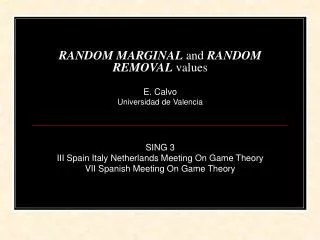
RANDOM MARGINAL and RANDOM REMOVAL values E. Calvo Universidad de Valencia SING 3III Spain Italy Netherlands Meeting On Game TheoryVII Spanish Meeting On Game Theory
(2) Random Removal (3) Random Marginal [ N={1,…,n} ] Start [ S={1,…,s} ] Active set Agreement Y N H&MC i leaves Breakdown RR RM i leaves [ S={1,…,s} ] Agreement Y N i leaves New active set Bargaining: (1) Hart and Mas-Colell (1996)
Monotonicity RM “optimistic” RR “pessimistic”
Characterization of RM and RR values Efficient S-utilitarian S-egalilitarian
Consistent value Maschler and Owen (1989) Shapley value (1953) Random Marginal value Hyperplane games TU-games
Solidarity value Nowak and Radzik (1994) Random Removal value TU-games
“mass” homogeneity Large market games RM value value allocation (core allocation)
“mass” homogeneity Large market games RR value Equal split allocation