Fostering Cooperation in the Arctic: The Need for a Unified Council among Diverse Nations
Achieving a permanent Arctic Council among nations with diverse interests presents challenges, yet the pursuit is crucial. As articulated by Tom Siddon, Canada's Minister of Indian Affairs and Northern Development, collaboration in this unique region is essential for addressing its geopolitical and environmental complexities. The Arctic encompasses specific climatic conditions and is home to around four million people, including various Indigenous groups like the Inuit and Saami. Strengthening ties between Arctic nations—such as Russia, Canada, and the United States—can promote mutual understanding and sustainable development.

Fostering Cooperation in the Arctic: The Need for a Unified Council among Diverse Nations
E N D
Presentation Transcript
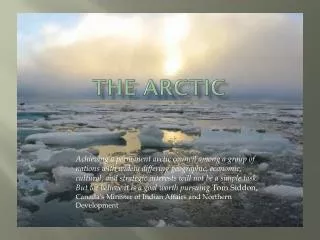
the arctIc Achieving a permanent arctic council among a group of nations with widely differing geographic, economic, cultural, and strategic interests will not be a simple task. But we believe it is a goal worth pursuing.Tom Siddon, Canada's Minister of Indian Affairs and Northern Development
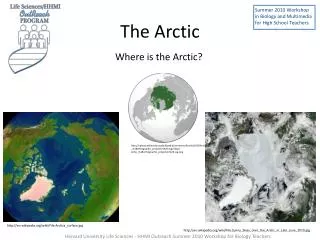
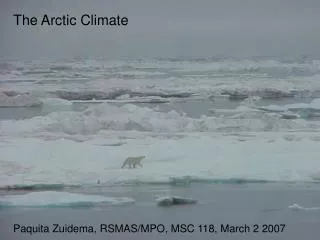
Many scientists define the Arctic as the area in the northern hemisphere where the average temperature does not rise above 10° C for any month of the year.
The Arctic is s the only place on Earth where a number of countries encircle an enclosed ocean. The Arctic nations: • Russia, • Canada, • Norway, • Finland, • Iceland, • Denmark (Greenland), • Sweden , • United States.
About four million people live in the Arctic. Indigenous peoples include the Inuit (Alaska, Canada, Greenland, Russia), Saami (Norway, Sweden, Finland, Russia), Athabascan Indians (Alaska, Canada), Aleut (Alaska, Russia).