Download
1 / 14
140 likes | 247 Vues
Learn about recent, current, and future education and training activities supporting Disaster Prevention & Mitigation. Explore topics from recent WMO Symposium to future plans in interdisciplinary training and outreach. Recommendations focus on targeted user groups and enhancing WMO Regional Training Centres. Stay updated on the latest initiatives in disaster risk reduction education.

E N D
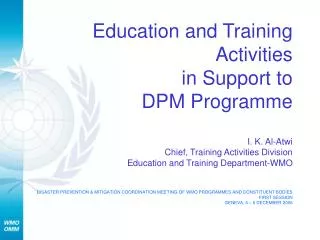
Education and Training Activities in Support to DPM ProgrammeI. K. Al-AtwiChief, Training Activities DivisionEducation and Training Department-WMODISASTER PREVENTION & MITIGATION COORDINATION MEETING OF WMO PROGRAMMES AND CONSTITUENT BODIESFIRST SESSION GENEVA, 4 – 6 DECEMBER 2006
ETR Activities in Support to DPM Programmea- Recent activitiesb- Current activitiesc- Future activities
Recent activitiesTenth WMO Symposium on Education and Training (SYMET-X), held from 18 to 22 September 2006 in Nanjing, China The theme of the Symposium Meteorological and hydrological education and training for Disaster Prevention and Mitigation.
Topic 1: Preparedness – Prevention and Early Warning:(15 Plenary sessions)·The “climatology” of climate change; statistics of extreme events ·Use and interpretation of ensemble prediction systems ·Infrastructures for early warnings (e.g. hurricane forecast, drought monitoring) ·Cost, loss and risk -based decision-making using probabilistic forecasts; SYMET-X Main Topics
Topic 2: Mitigation – Emergency, Relief and Rehabilitation: (11 plenary sessions) • Meteorological and hydrological products for emergency measures • Use of satellite data and imagery to identify and monitor disasters • Reduction of the impact of disaster occurrences • Outreach activities in meteorology and hydrology
Topic 3: Interdisciplinary training (15 Plenary sessions) • Meteorology for non-meteorologists • Hydrology and flood forecasting for non-hydrologists • Popular and school education in meteorology and hydrology • Public awareness raising education for disaster risk reduction
SYMET-X Overview140 Training Experts from 54 countries 41 Plenary presentations and29 Poster presentations
Noted Facts;1- Most natural disasters are meteorological or hydrological in origin and are increasing in intensity and frequency2- NMHSs have key role in DPM3- There is a gap in training and education relating to the disaster prevention and mitigation
Recommendations:1.Encourage meteorological / hydrological education and training for targeted user groups, including public, media, schools, emergency responders and others, through:a)Engaging other WMO and UN groups and making use of the potential of partnershipsb)Sharing of existing resources including those relating to meteorology/hydrology and natural disasters;
2.Promote:a)The development of training on the use of ensemble forecasts for meteorologists and hydrologists, with special emphasis on the support for risk assessment by decision- makers; b)The use of probabilistic forecasts by agriculture groups, emergency managers, health authorities, aviation operators and regulators, and other economic sectors;
3.Further enhance the capacities of the WMO Regional Training Centres and training units of NMHSs through:a)Special training modules on disaster prevention and mitigation;b)The development of guidance for short courses on risk assessment of natural disastersc)Emphasis on training on the use of remote- sensed datad)Addressing the need for NMHSs to train in areas such as management and communicatione)The use of computer-aided distance learning (CADL) for large and geographically dispersed groups including real-time weather discussion
Current activitiesa) Introduction of the DPM as a standing topic (One day training ) in ETR’s Regional Seminars for the Training of Trainersb) Developing a plan for the implementation of SYMEX-X recommendationsc) Promotion of Distance Learning and improving communications with Technical and Scientific Departments, WMO-RTCs and others.
Future activitiesa) Endorsement of the Symposium Recommendations by the EC-Panel of Experts on Education and Training and the Executive Council during the forthcoming meetingsb) Production of a new Supplement for WMO-No-258 on DPMc) Compile and Develop as needed, public education and outreach materials for Schools, Disaster Risk Managers, Authorities and also for Ministers.