Lecture 5.2: Integumentary System
This lecture explores the integumentary system, focusing on the epidermis's role in synthesizing Vitamin D3 when exposed to UV rays. We discuss the consequences of decreased Vitamin D levels, including abnormal bone growth and the risk of skin cancer, the most common cancer affecting humans. Key elements of skin structure are reviewed, including the dermis layers and components like hair follicles and sweat glands. Understanding these aspects aids in comprehending skin function, health, and disease prevention.


Lecture 5.2: Integumentary System
E N D
Presentation Transcript
Epidermis and Vitamin D3 • UV rays cause cholesterol-like steroid to change to vitamin D3 • Decreased Vitamin D leads to abnormal bone growth
Skin Cancer • Most common cancer • Most people survive • Treatment = removal of tumor • Melanomas—extremely dangerous • Usually begin as mole • Grow rapidly • Spread via lymphatic system
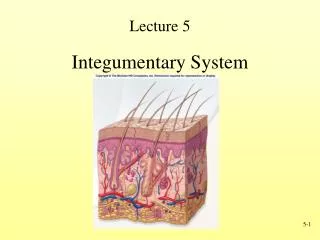
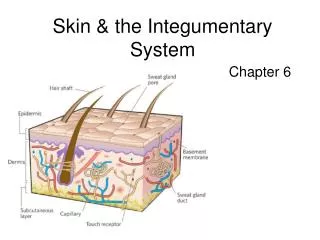
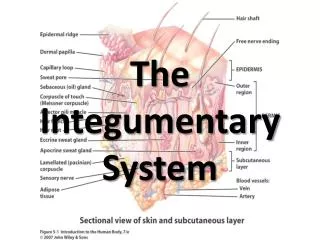
Dermis—Layers • Papillary Layer • Supports and nourishes epidermis • Capillaries and nerves for skin surface are here • Reticular Layer • Elastic fibers for elasticity • Collagen fibers limit elasticity for protection
Other Dermal Components • Hair Follicles • Sweat Glands
Subcutaneous Layer • Increased adipose cells • Decreased heat loss in infants • Energy reserve • Shock absorber
Hair • Everywhere except: • Sides and soles of feet • Palms • Sides of fingers/toes • Lips • Parts of genitalia
Hair cont… • Hair follicles—where hair is produced • Hair papillae—where vessels and nerves are • Hair root—anchors hair into skin • Hair shaft—what we see • Cuticle—surface layer of hair • Grows about 0.3 mm/day • May become inactive for awhile
Hair cont… • Round hairs = straight hair • Flattened hairs = curly hair • Functions • Protect from UV rays • Cushion light blows • Insulate • Prevent entry of pathogens
Hair cont… • Sensory nerve fiber at base • Arrectorpili—bundle of smooth muscle • Causes hair to stand up • “Goosebumps”
Hair Color • Due to amounts of pigment produced by melanocytes • Due to genetics • Pigment production decreases with age • No pigment = white hair
Hair Loss • Average about 50 hairs/day • More than 100 hairs/day = hair loss • Temporarily due to: • Drugs • Diet • Radiation • High Fever • Stress • Pregnancy
Sebaceous Glands • AKA: Oil Glands • Secrete into hair follicle • Sometimes onto skin • Secreted through arrectorpili • Sebum—secretion of oil • Lubricates hair and skin • Inhibits bacteria • High amounts at puberty • Acne—sebaceous duct blocked • Secretions accumulate • Causes pimples
Sweat Glands • Apocrine Glands • Secrete into armpits, nipples and groin • Sticky, cloudy, odorous secretion • Starts at puberty • Odorous when bacteria feed on sweat