The Dissolution of the Union: Conflicts Leading to the Civil War
The mid-19th century was a tumultuous time in American politics, marked by the dissolution of the Republican Party and the rise of sectional tensions. The Northern Whigs, unhappy about the Kansas-Nebraska Act, began collaborating with anti-slavery Democrats. The election of 1856 culminated in a contest between John C. Fremont (R) and James Buchanan (D), framed as a struggle to save the Union by yielding to Southern demands. However, the Lincoln-Douglas debates highlighted the slavery issue, with Lincoln advocating against its spread. As tensions escalated, Lincoln's victory in 1860 sparked secession, leading to the formation of the Confederate States of America.

The Dissolution of the Union: Conflicts Leading to the Civil War
E N D
Presentation Transcript
Republican Party • Northern Whigs • upset over KS-NB Act • worked with Antislavery Democrats
Election of 1856 • John C. Fremont (R) • James Buchanan (D) • Best way to save Union = give in to the South • “Only Buchanan can save the Union.”
Lincoln-Douglas Debates • Republicans choose unknown to run against Douglas • Slavery • Lincoln – morally wrong, shouldn’t spread • Douglas – popular sovereignty • Douglas won • Lincoln received attention for future
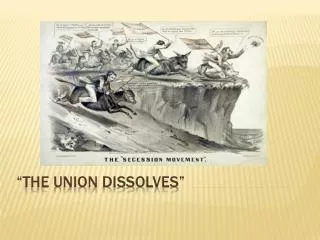
Election of 1860 • Candidates • Abe Lincoln (R) • Stephen A. Douglas (D) • John Breckinridge (D) • John Bell (Union Party) • Lincoln swept the northern states, won election • South Carolina almost immediately seceded from the Union • 6 states followed – AL, MS, GA FL, LA, TX
Confederacy • met in Montgomery, AL • named the Confederate States of America • (CSA) • Constitution based on U.S. constitution • Jefferson Davis (MS) = president
Ft. Sumter • Lincoln wanted to re-supply fort • Davis decided to attack • CSA attacked for 33 hours until the Sumter surrendered