
All About Digestive System: Function & Structure
E N D
Presentation Transcript
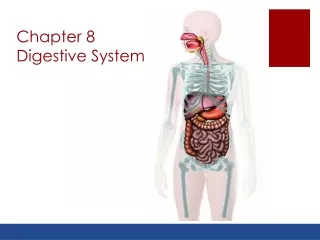
Chapter 17 - Digestive System • Digestion - process by which food is changed into forms that can be absorbed through cell membranes.
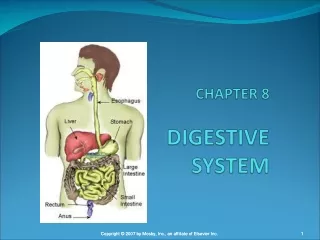
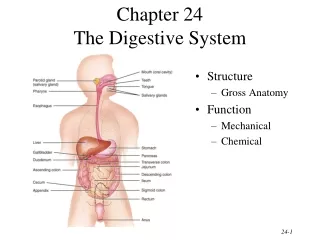
General Characteristics of the Alimentary Canal (GI Tract) • Extends from mouth to anus (about 9m long) • Organs include: mouth, pharynx, esophagus, stomach, small intestine, and large intestine • Accessory organs: salivary glands, liver, gall bladder, pancreas
Structure of the wall- 4 layers • 1. Mucosa • 2.Submucosa • 3. Muscularis • 4. Serosa
Mucosa • innermost layer • made of epithelial and connective tissue and some smooth muscle • has glands that secrete mucus for lubrication and protection from digestive enzymes
Submucosa • beneath mucosa • contains connective tissue, glands, blood vessels lymph vessels, and nerves • nourishes mucosa and carries absorbed nutrients away
Muscularis • 2 layers of muscle (smooth) • circular muscle layer around submucosa • longitudinal layer around circular layer • function is to move food through the canal (mixing & peristalsis
Serosa • outermost layer • protects underlying tissues • secretes serous fluid to lubricate outer tube so organs slide freely against each other
. Movements of the tube • 1. Mixing • Smooth muscles contract rhythmically • Mix food, digestive juices, and mucus • 2. Peristalsis • Wavelike motion of longitudinal muscle layer to move food along • Begins when food expands the tube
Movements of the Tube • mixing movements • peristalsis
Innervention of the Tube 1. Parasympathetic NS (autonomic NS) • Increases digestive activities • In control under normal, restful conditions 2. Sympathetic NS (autonomic NS) • In control in stressful situations • Contract sphincter muscles (blocks movement of food) - found between organs of GI tract • Inhibits digestive activities
Mouth (Fig 17.7 page 650) • Receives food and starts digestion by chewing and mixing with saliva • Cheeks and lips Tongue • Muscular organ that mixes and moves food
Palate • roof of mouth • Hard palate - anterior portion • Soft palate - posterior portion • Uvula - extension of soft palate • Tonsils - masses of lymphatic tissue - Palatine tonsils (lateral to palate) - Pharyngeal tonsils = adenoids (posterior pharynx)
Mouth • ingestion • mechanical digestion • prepares food for chemical digestion
Palate • roof of oral cavity
Teeth • 2 sets develop in sockets in mandibular and maxillary bones • 20 primary (deciduous) lost between 6-12 years • 32 secondary (permanent) • function is to break food into smaller pieces
Primary Teeth • 8 incisors • 4 cuspids • 8 bicuspids • 12 molars
4 types of teeth - incisors, cuspid, bicuspids, molars (fig 17.9 page 656)
tooth structure (fig 1 7.10 page 657) • crown = exposed area of tooth • root = area below gum (gingiva) • enamel = covering on crown made ofCa+ salts (hardest substance in body) • dentin = bulk of tooth under enamel
pulp = central cavity that contains blood vessels, nerves, and connective tissue • cementum = encloses root • periodontal ligament = attaches tooth to jaw • See Clinical application 17.1 page 657 - effects of bacteria on teeth
Salivary Glands • Secretes saliva to moisten and bind food and begins digestion of carbohydrates • Helps cleanse mouth and regulate pH (6.5 - 7.5) • Makes taste possible
Salivary secretions • Serous cells secrete amylase (enzyme) to start carbohydrate digestion • Mucus cells secrete mucus for lubrication
Major Salivary Glands (fig 17.11 page 658) Parotid • Anterior to ear • largest • secrete saliva rich in amylase Submandibular • located on floor of mouth • secrete viscous saliva
Sublingual • located inferior to tongue • secretes mostly mucus
Pharynx (throat) • divided into 3 parts Nasopharynx • superior to soft palate • passageway for air during breathing Oropharynx • posterior to mouth • passageway for food and air moving to and from nasal cavity
Laryngopharynx • inferior to oropharynx • passageway to esophagus
Esophagus • Straight collapsible tube about 25cm long • Passageway for food from pharynx to stomach • Posterior to trachea (tube to lungs) • See hiatal hernia page 661 • Lower esophageal sphincter muscles usually remains contracted to prevent regurgitation of stomach contents
Stomach • J shaped pouchlike organ 25-30cm long • Inner has thick mucosal folds called rugae - pg 662 fig 17.17 • Pyloric sphincter muscle found at entrance to small intestine (duodenum) • Mixes food with gastric juice, initiates digestion of proteins, carries on a limited amount of absorption, and moves food to small intestines.
Gastric secretions • Mucosa of stomach has gastric pits that are the openings of gastric glands. Page 664 fig 17.19 • Gastric juice contains: see page 665 table 17.5
Gastric Secretions • mucus • from goblet cells and mucous glands • protective to stomach wall • pepsinogen • from chief cells • inactive form of pepsin • pepsin • from pepsinogen in presence of HCl • protein splitting enzyme • intrinsic factor • from parietal cells • required for vitamin B12 absorption • hydrochloric acid • from parietal cells • needed to convert pepsinogen to pepsin
Regulation of Gastric Secretions Parasympathetic NS (normal conditions) - stimulates release of the hormone gastrin which increases the activity of gastric glands - hormone somatostatin inhibits acid secretion
Gastric Absorption • Stomach wall not well adapted to absorb digestive products • Only small quantities of water, certain salts, alcohol and some lipid soluble drugs are absorbed
Mixing and emptying actions • Mixing of food + gastric juice = chyme • Peristalsis moves chyme toward small intestine • Pyloric sphincter relaxes (opens) & chyme is pushed a little at a time into small intestine • Enterogastric reflex inhibits peristalsis in stomach as small intestine fills
Enterogastric Reflex regulates the rate at which chyme leaves the stomach
Vomiting • Caused by irritation or distension in stomach or intestines • Can be stimulated by drugs, toxins in foods, rapid changes in body motion, sights, sounds, odors, tastes, emotions and mechanical stimulation of back of pharynx • Vomit center is in medulla oblongata • Stomach is squeezed from all sides forcing contents upward • Nausea caused by activity in or near vomit center
Pancreas (accessory organ) • Secretes digestive juice called pancreatic juice Structure • Its head is found in C-shaped curve of duodenum and tail against the spleen • Page 668 Fig 17.23 • Pancreatic duct connects to small intestine at the same place as the bile duct from the liver and gallbladder