Geologic Features of Mars
110 likes | 239 Vues
Mars’ geological features reveal a striking crustal dichotomy between its northern and southern hemispheres. The southern hemisphere, 5 km higher and 70 km thick, is marked by numerous craters, while the northern hemisphere is smoother, lower, and only 40 km thick, indicating a resurfacing process that erased many craters. The main processes of crust formation include erosion, volcanism, impact craters, and tectonism. Mars hosts the largest volcanoes in the solar system, like Olympus Mons, and the Valles Marineris, the longest canyon, showcasing its complex geological history.


Geologic Features of Mars
E N D
Presentation Transcript
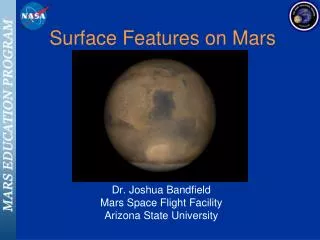
Crustal Dichotomy of Mars • Striking difference between northern and southern hemispheres • Southern hemisphere is 5 km higher than northern, is 70 km thick • Southern hemisphere has lots of craters of all sizes • Northern hemisphere is lower than southern, is smooth and has been resurfaced by some process that eradicated craters and is 40 km thick
Main Processes of Crust Formation • Erosion • Volcanism • Impact craters • Tectonism
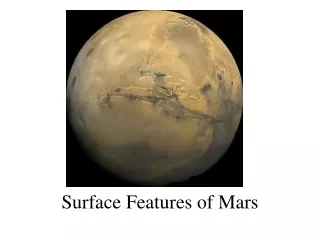
Erosion • Current and dominant process • Mass movement • Landslides • Sinking • Aeolian • Dunes • Windstreaks – downwind from a crater by deposition or erosion • Water • Valleys – Valles Marineris (LA→NY), maybe a rift valley(crust breaks apart along a fault line)
Volcanism • Mars has largest volcanoes of solar system • Olympus Mons – huge volcano bigger than Hawaii, one of 4 in Tharsis • Volcanism produced • Lava flows • Shield volcanoes • Calderas
Volcanism contd • Shield volcanoes have a steep cliff wall called a scarp • They also have a caldera • the largest and most explosive volcanic eruptions eject tens to hundreds of cubic kilometers of magma. When such a large volume of magma is removed from beneath a volcano, the ground subsides or collapses into the emptied space, to form a huge depression called a caldera
Impact Craters • Produced by comets and asteroids • Tapered off ~3.8 billion years ago • Older surfaces have more craters • Older craters are larger • Older craters are more eroded • Can guess age by superposition and crosscutting
Tectonism • Mars has only 1 tectonic plate (Earth has 7) • Tectonic stress leads to subsurface uplift • Extensional stress led to valley formation • Valles Marineris is longest canyon in solar system
Tectonic Plates of Earth http://geology.er.usgs.gov/eastern/plates.html
Magnetic Field of Mars • No planetwide field • Some weakly magnetized regions in old southern highlands • Martian core has S in addition to Fe • Molten S core does not produce electrical currents, so no planetwide magnetic field