Momentum and Collisions in Physics
160 likes | 262 Vues
Explore the concepts of linear momentum, impulse, and conservation of momentum in collisions, including elastic and inelastic collisions, to understand the forces and changes in momentum.


Momentum and Collisions in Physics
E N D
Presentation Transcript
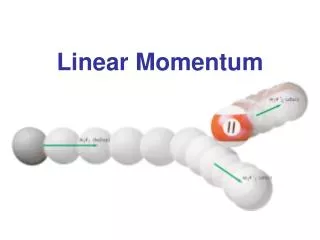
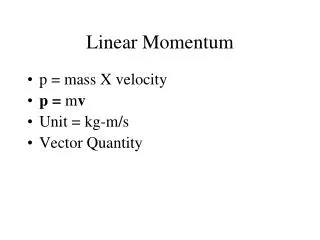
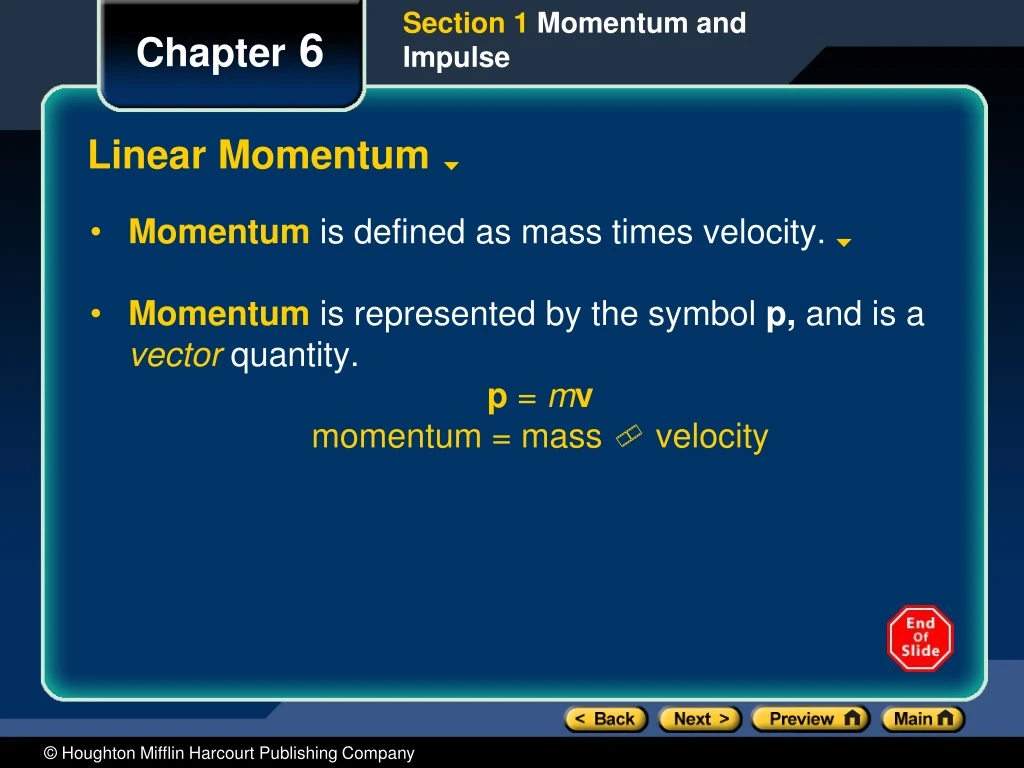
Section 1 Momentum and Impulse Chapter 6 Linear Momentum • Momentum is defined as mass times velocity. • Momentumis represented by the symbol p, and is a vector quantity. p = mv momentum = mass velocity
Section 1 Momentum and Impulse Chapter 6 Momentum Click below to watch the Visual Concept. Visual Concept
Section 1 Momentum and Impulse Chapter 6 Linear Momentum, continued • Impulse • The product of the force and the time over which the force acts on an object is called impulse. • The impulse-momentum theorem states that when a net force is applied to an object over a certain time interval, the force will cause a change in the object’s momentum. F∆t = ∆p = mvf – mvi force time interval = change in momentum
Section 1 Momentum and Impulse Chapter 6 Impulse Click below to watch the Visual Concept. Visual Concept
Section 1 Momentum and Impulse Chapter 6 Impulse-Momentum Theorem Click below to watch the Visual Concept. Visual Concept
Section 2 Conservation of Momentum Chapter 6 Objectives • Describe the interaction between two objects in terms of the change in momentum of each object. • Compare the total momentum of two objects before and after they interact. • State the law of conservation of momentum. • Predict the final velocities of objects after collisions, given the initial velocities, force, and time.
Section 2 Conservation of Momentum Chapter 6 Momentum is Conserved The Law of Conservation of Momentum: The total momentum of all objects interacting with one another remains constant regardless of the nature of the forces between the objects. m1v1,i+ m2v2,i = m1v1,f + m2v2,f total initial momentum = total final momentum
Section 2 Conservation of Momentum Chapter 6 Conservation of Momentum Click below to watch the Visual Concept. Visual Concept
Section 2 Conservation of Momentum Chapter 6 Momentum is Conserved, continued • Newton’s third law leads to conservation of momentum • During the collision, the force exerted on each bumper car causes a change in momentum for each car. • The total momentum is the same before and after the collision.
Section 3 Elastic and Inelastic Collisions Chapter 6 Objectives • Identify different types of collisions. • Determine the changes in kinetic energy during perfectly inelastic collisions. • Compare conservation of momentum and conserva-tion of kinetic energy in perfectly inelastic and elastic collisions. • Find the final velocity of an object in perfectly inelastic and elastic collisions.
Section 3 Elastic and Inelastic Collisions Chapter 6 Collisions • Perfectly inelastic collision A collision in which two objects stick together after colliding and move together as one mass is called aperfectly inelastic collision. • Conservation of momentum for a perfectly inelastic collision: m1v1,i + m2v2,i = (m1 + m2)vf total initial momentum = total final momentum
Section 3 Elastic and Inelastic Collisions Chapter 6 Perfectly Inelastic Collisions Click below to watch the Visual Concept. Visual Concept
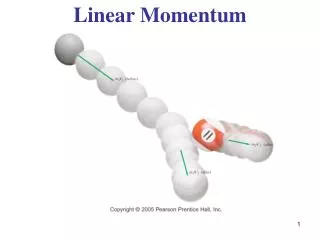
Section 3 Elastic and Inelastic Collisions Chapter 6 Elastic Collisions • Elastic Collision A collision in which the total momentum and the total kinetic energy are conserved is called anelastic collision. • Momentum and Kinetic Energy Are Conserved in an Elastic Collision
Section 3 Elastic and Inelastic Collisions Chapter 6 Sample Problem, continued Elastic Collisions A 0.015 kg marble moving to the right at 0.225 m/s makes an elastic head-on collision with a 0.030 kg shooter marble moving to the left at 0.180 m/s. After the collision, the smaller marble moves to the left at 0.315 m/s. Assume that neither marble rotates before or after the collision and that both marbles are moving on a frictionless surface.What is the velocity of the 0.030 kg marble after the collision?
Section 3 Elastic and Inelastic Collisions Chapter 6 Types of Collisions Click below to watch the Visual Concept. Visual Concept