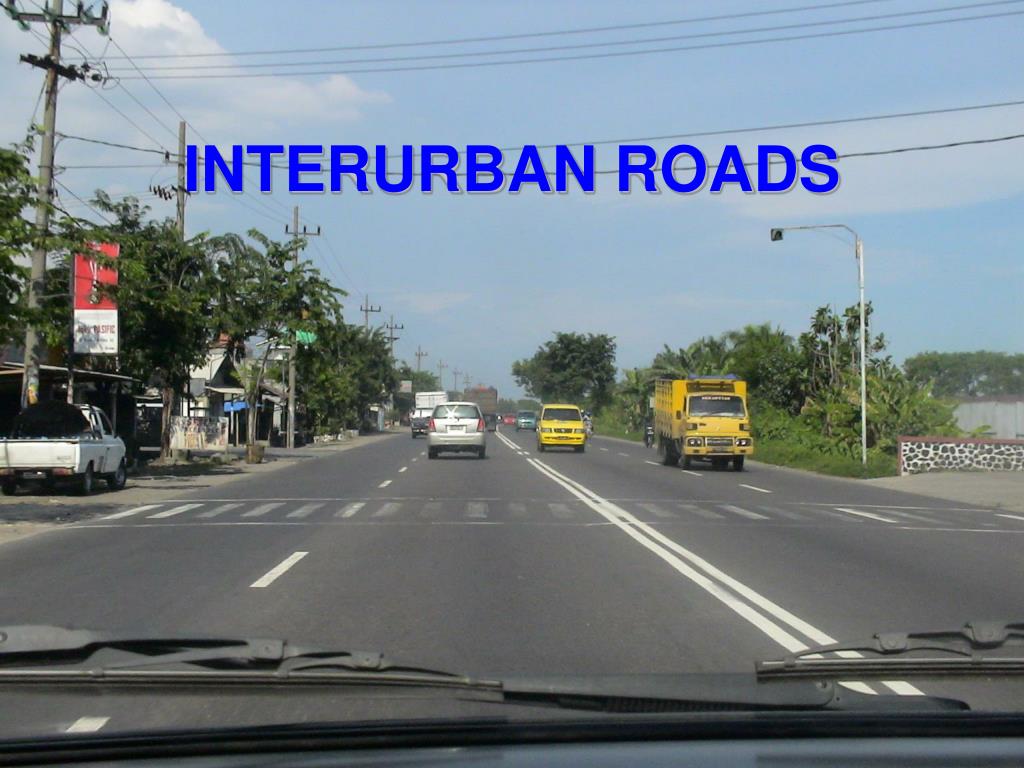
INTERURBAN ROADS. Scope of Interurban Roads. Interurban Road Segments without continuous development on either side, such as restaurants, factories, or villages.
Une image / un lien ci-dessous est fourni (tel quel) pour télécharger la présentation
Politique de téléchargement : le contenu du site vous est fourni TEL QUEL pour votre information et votre usage personnel ; il ne peut être vendu, concédé sous licence ni partagé sur d’autres sites sans l’accord de son auteur.Le contenu vous est fourni TEL QUEL, pour votre information et votre usage personnel uniquement.Téléchargez la présentation en cliquant sur ce lien.Lors du téléchargement, si vous ne parvenez pas à télécharger une présentation, l’éditeur a peut-être supprimé le fichier de son serveur.Pendant le téléchargement, si vous ne parvenez pas à obtenir une présentation, le fichier a peut-être été supprimé par l’éditeur.
Scope of Interurban Roads • Interurban Road Segments without continuous development on either side, such as restaurants, factories, or villages. • Urban/Suburban Road Segments continuous permanent development along all or almost of its length, on at least one side of the road. Population at least 100.000
Scope of Interurban Roads • Conditions: • Flat, rolling or hilly alignment • Specific grades (e.g. climbing lane)
Scope of Interurban Roads • Road Segments: • Between and unaffected by major intersections, and • Having similar geometric design and traffic flow and composition along its length.
Objective of Interurban Roads • Design of interurban roads should be selected with the aim to ensure that degree of saturation does not exceed an acceptable value (normally 0,75)
Traffic Safety Considerations • Widening of the lane decreases the accident rates between 2-15% per meter widening (the high number refers to small roads). • Widening and improvement of shoulder surface conditions improves traffic safety, although to a smaller degree than lane widening
Traffic Safety Considerations • Climbing lane in steep grades reduce the accident rate with 25-30%. • Passing lanes (extra lanes for overtaking in flat terrain) reduce the accident rate with15-20% • Straightening of isolated, sharp curves reduces accident rates with 25-60%
Traffic Safety Considerations • A median reduces the accident rate with 30% • Median barriers (used when the space is insufficient to make a full median) reduce fatal and severe injury accidents with 10-30%, but increase damage only accidents.
Interurban Roads Performance Indicator • Degree of Saturation (≤ 0,75) • Level of Service (A – F) • Actual Free-Flow Speed • Travel Time • Degree of Bunching • Actual Uphill Speed (*) • Uphill Travel Time (*)
STEP A-1: General Data • Date (day, month, year) and Handled by • Province • Link number/road name • Segment code • Segment between … or … • Administrative road class (National, Provincial or Kabupaten) • Road type (4/2 D, 4/2 UD, 2/2 UD, 2/1) • Length of segments • Road function (Arterial, Collector or Local) • Time period • Case number
STEP A-2: Geometric Conditions • Compass arrow showing North • Km-posts • Sketch of the horizontal alignment • Arrows identifying Direction 1 (North or East-bound) and Direction 2 (South or West-bound) • Names of the places • Major buildings • Intersections and entries/exits • Pavement markings
STEP A-4: Side Friction • Number of pedestrians passing along or crossing the road segment (0,6) /h, 200m • Number of stopping vehicles and parking maneuvers (0,8) /h, 200m • Number of motor vehicle entries and exists to/from roadside properties and side roads (1,0) /h, 200m • Flow of slow-moving vehicles (bicycles, tricycles, horse-charts, oxcarts, tractors, etc.) (0,4) /h
STEP B-1: Analysis of Free-flow Speed • FV free-flow speed for LV at actual conditions (kph) • FV0 Base free-flow speed for light vehicles (kph) • FVW Adjustment for effective carriageway width (km/h) • FFVSF Adjustment factor for side friction conditions • FFVRC Adjustment factor for road function class
STEP C-5: Determination of Capacity for Actual Condition • C Capacity (pcu/h) • C0 Base capacity (pcu/h) • FCW Adjustment factor for carriageway width • FCSP Adjustment factor for directional split • FCSF Adjustment factor for side friction
STEP C-6: Determination of Capacity for Specific Condition • C Capacity (pcu/h) • C0 Base capacity (pcu/h) • FCW Adjustment factor for carriageway width • FCSP Adjustment factor for directional split • FCSF Adjustment factor for side friction
STEP D-1: Degree of Saturation • Q Traffic flow (pcu/h) • Q IR-2 (column 14 row 5 for undivided road) • Q IR-2 (column 14 row 3 & 4 for each direction of travel on divided road) • C Capacity (pcu/h) • C IR-3 (column 15)
STEP D-2: Speed and Travel Time • Determine the speed at actual traffic • Figure D-2:1 (two-lane undivided roads) • Figure D-2:2 (four-lane undivided roads) • Enter segment length (km) in column 24 Form IR-3 • Calculate average travel time (hour) for Light Vehicle
STEP D-3: Degree of Bunching (Platooning) • Determine Degree of Bunching (DB) on two-lane two-way undivided roads based on Degree of Saturation (DS) column 22 Form IR-3, see figure D-3:1 or using equation: