Teaching and Admonishing Through Hymns: Insights from Colossians 3:16
Discover the importance of studying hymns as a means of teaching and admonishing in the faith, rooted in Colossians 3:16. Understanding the lyrics of our songs helps us and our younger or new believers grasp profound spiritual truths. This guide covers tools for hymn study, examines the significance of hymn composers, and emphasizes recognizing Biblical phrases within hymns. Explore specific hymns, their meanings, and the contexts in which we can incorporate them into worship and teaching, ensuring that we sing with comprehension and purpose.

Teaching and Admonishing Through Hymns: Insights from Colossians 3:16
E N D
Presentation Transcript
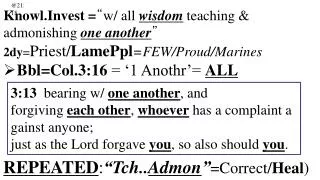
Teaching and Admonishing What We Learn From Psalms, Hymns and Spiritual Songs Colossians 3:16
Why Study Hymns? • Making melody in our heart involves understanding what we sing (Eph. 5:16) • Teaching and admonishing involves understanding what we sing (Col. 3:16) • New converts / children may not understand the words and phrases of our hymns • Songs, like Scripture (Acts 8:30), are more meaningful when we understand what we are reading
Why Study Hymns? • We do not speak today in the Old English that was often used to compose hymns • Understanding something about the composer of a hymn can illustrate the meaning of that hymn • Bible words and phrases used in hymns must be understood
When Can We Study Hymns? • Sermon in song • A Wednesday night talk • Around the Lord’s table • Song leader can briefly explain words or phrases before each song • Singing service • Bible class setting • Singing at home
Tools For Hymn Study • To Study the English Words: a good Webster’s English dictionary (including etymology) • To Study the Composer: good books on hymn origins • “Then Sings My Soul,” Robert J. Morgan • “A Song is Born,” Robert J. Taylor • “A Hymn Is Born,” Clint Bonner • To Study Bible words and phrases: a good Bible concordance (Bible software for computer)
Five Areas of Hymn Study • Songs with words defined • Songs based on scriptures • Songs with misapplied scriptures • Songs with incorrect messages • Songs that are misapplied
Songs with Words Defined • He Leadeth Me (407) • “fraught” = filled • “bowers” = dwelling, retreat, shelter, arbor • I Know Whom I Have Believed (237) • “vale” = valley, a low point • Wonderful Love of Jesus (155) • “lays” = simple poem, balled, melody, song • “balm” = aromatic, soothing ointment
Songs with Words Defined • Nearer, Still Nearer (125) • “haven” = harbor, port, place of safety • “pomp” = vain show, display • We’ll Work Till Jesus Comes (396) • “bade” = past tense of “bid” (invite) • “succor” = relief, aid, help • Beautiful Isle • “repining” = discontent, longing for something • “guerdon” = reward, recompense • “rifted” = cracked, separated, parted • “isle” = island
Songs Based on Scriptures • On Jordan’s Stormy Banks I Stand (Ex. 15; Rev. 15:3) • Flee As A Bird to Your Mountain (Psa. 11:1) • Ivory Palaces (Psa. 45:6-8) • Though Your Sins Be As Scarlet (Isa. 1:18) • Some Day The Silver Cord Will Break (Eccl. 12:1-6) • We Have An Anchor (Heb. 6:18-19) • In the Land of Fadeless Day (Rev. 21:16,21) • Beulah Land (Isa. 65:1-5)
Songs with Misapplied Scriptures • Prepare to Meet Thy God (based on Amos 4:12 referring to Israel sentenced to judgment, not getting prepared for judgment) • Jesus Is Coming Soon (second verse misapplies Matthew 24)
Songs with Incorrect Messages • Christ Receiveth the Sinful Men (“satisfied its last demand”) • Rock of Ages (“Be of sin the double cure…”)
Songs That Are Misapplied • Break Thou the Bread of Life (based on John 6, but often used for the Lord’s supper) • Stand Up, Stand Up for Jesus (refers to our attitude of heart, not standing up)
What Will You Do With Jesus? • Albert B. Simpson, Scottish, born 1843, his hymns were known for their complexity, composed 1897 • Verse 1 “Pilate’s hall” – Mt. 27:2 “Friendless, forsaken, betrayed by all” – Mt. 26:56 “Hearken” = give careful attention, listen carefully “What will you do with Jesus?” – Mt. 27:22 • Verse 2 “false” … “faithful” … “good” … “ill” (bad, evil, harm)
What Will You Do With Jesus? • Verse 3 “evade” = avoid, escape, get away “evade Him as Pilate did” – Mt. 27:24 “what e’er (ever) betide” = to happen “vainly” = useless, without success • Verse 4 “like Peter, your Lord deny” = Mt. 27:69ff “scorn” = mock, disgrace, disdain, contempt “foes” = enemies “daring” = fearless, bold, courageous
What Will You Do With Jesus? • Verse 5 “follow Thee all the way” – Lk. 9:57; Jn. 13:36-38 • Chorus “neutral you cannot be” – Mt. 12:30; Mk. 9:40 “What will he do with me?” – Mt. 10:33; 2 Tim. 2:12
After the Midnight • James Rowe, England, born 1865, wrote more than 19,000 song texts, composed 1915 • Verse 1 “midnight” = end of life’s journey “tempest” = violent storm “jeering” = to make fun of, mock, taunt, scoff • Verse 2 “After the battle” – Eph. 6:10ff “weeping” – Rom. 12:15 “journey” = life’s journey “burdens” – Gal. 6:2,5
After the Midnight • Verse 3 “all through the story” = life’s story “shadows … sunshine” = bad times and good times • Chorus “shadows … sunshine” = life on earth, life in heaven “cling” = hold on to tightly (Josh. 22:5; 23;8) “All will be well” = when we go to heaven
A Wonderful Savior • Fannie J. Crosby, born 1820, blind at age 6, lost a child, lived separated from her husband, wrote over 8,000 hymns, lived to be 95, memorized large portions of Scripture, composed this song in 1890 • Verse 1 “A wonderful Savior” – Isa. 9:6
A Wonderful Savior • Verse 2 “burden away” – burden of sin, daily burdens “shall not be moved” – Psa. 16:8; 21:7; 46:5; 62:6 “giveth me strength” – Eph. 6:10 • Verse 3 “numberless blessings” – Eph. 1:3 “filled with His fulness divine” – Eph. 3:19; 4:13; Col. 2:9-10 “sing in my rapture” – carried away with joy, love, pleasure, excitment
A Wonderful Savior • Verse 4 “clothed in his brightness” – Phil. 3:20-21 “clouds of the sky” – 1 Thess. 4:13-17 “millions on high” – Rev. 5:11-12 • Chorus “cleft of the rock” = crack, crevice, split in the rock (Ex. 33:22), place of protection “dry, thirsty land” = life here on earth (Psa. 63:1; Isa. 32:2; 35:1; 41:18) “depths of His love” – Rom . 11:33; Eph. 3:18