Discovering Ancient Civilizations: Art, Science, and Society
Explore the fascinating world of ancient civilizations characterized by remarkable advancements in arts, science, and law. Learn about key concepts such as irrigation, cuneiform writing, and the significance of Pharaohs and pyramids in ancient Egypt. Delve into the social structures depicted through caste systems and dynasties. Discover the importance of trade routes like the Silk Road and innovations in architecture. Understand varied governance systems from monarchies to republics and the interconnectedness of cultures through colonization and commerce.

Discovering Ancient Civilizations: Art, Science, and Society
E N D
Presentation Transcript
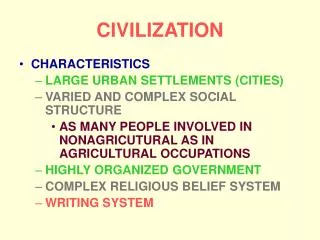
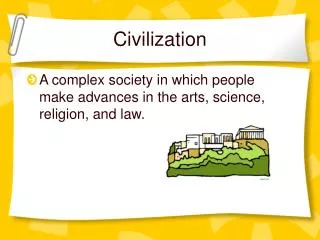
Civilization • A complex society in which people make advances in the arts, science, religion, and law.
Irrigation • Using ditches and canals to bring water to a dry place.
Cuneiform • Style of writing that used wedge shapes.
ancient Very old
Pharaoh • A king of ancient Egypt.
pyramid • A stone monument that served as a tomb in ancient Egypt.
mummy • A body prepared in a special way for burial.
hieroglyphics • A kind of writing based on pictures and signs.
subcontinent • A large mass of land that is part of a continent.
caste • A social class into which people are born.
Dynasty • A family that rules for several generations in a row.
Compass • A device with a magnetic needle that points north.
Silk Road • The long route that linked China with the rest of Asia and Europe.
City-state • A city or town and its surrounding lands.
Alphabet • A set of symbols that stand for spoken sounds.
Republic • Government in which people vote for leaders to represent them.
Empire • A group of nations joined under one government.
Architecture • The design of buildings
Aqueduct • The system of pipes and waterways that carries water.
Manor • Farmland owned by a lord or lady.
Peasant • A poor farm worker.
Commerce • The buying and selling of foods.
Guild • A group of people who do the same work and are joined together for an economic reason.
Renaissance • In Europe, a period of new interest in art, literature, science, and architecture.
Monarchy • A nation ruled by one person.
Colonization • The act of setting up colonies.
Dictatorship • A government with a single leader.
Communism • A system in which the government, not the people, owns the country’s land, resources, and means of production.