Shoulder Dystocia
350 likes | 778 Vues
Explore the definition, incidence, fetal and maternal outcomes, prevention strategies, warning signs, and mnemonic for managing shoulder dystocia, a critical obstetric complication. Learn about the mechanism, maneuvers, and conclusion regarding this emergency.


Shoulder Dystocia
E N D
Presentation Transcript
Shoulder Dystocia Dr. Reza Nasr MD MRCOG DFFP Consultant in Obstetrics and Gynaecology University of London
Shoulder Dystocia • Most dreaded unanticipated Obstetric Complication • Major cause of maternal and perinatal mortality and morbidity • Costly source of litigation
Definition and Incidence • Defined as a range of difficulties encountered with delivering the shoulders after delivery of the head, 0.15-2% of all deliveries • Many attempts have been made to try and standardise the definition and therefore the incidence reporting • Efforts have been made to define different degrees of difficulty, ie Mild, moderate and severe
Fetal Mortality and Morbidity • Major cause of mortality and morbidity, Cemach 1993 reported this as a cause in 8% of all deaths • Overall improvement over last 30 years but must not become complacent • Cemach 1998 Focus group on shoulder dystocia found that in 66% of deaths, this was due to level 3 substandard care.
Reasons for fetal Mortality and morbidity • Following delivery of head, fetal pH drops by 0.04 units per minute • Delay may result in asphyxia, which can cause permanent neurological injury • Delivery should occur within 5 minutes, >10 minutes more likely to cause permanent injury • Also Brachial plexus injury ie Erb’s palsy, which usually resolves in 6 months
Maternal morbidity • Postpartum haemorrhage is common following shoulder dystocia • Vaginal and perineal lacerations • Strong association between 3rd and 4th degree tears and shoulder dystocia • Uterine rupture may also happen
Prevention • No evidence that Induction of labour for big baby improves maternal or fetal outcome • Women with Diabetes and Macrosomia, induction may reduce number of deliveries complicated by macrosomia • Elective caesarean not recommended to reduce shoulder dystocia in non diabetic women NNT 2345
Warning signs • Prolonged second stage • Head bobbing, which is retraction of head back into the pelvis between contractions • Turtle sign at delivery, ie the delivered head gets pulled back towards the perineum • Plan is to increase the available pelvic diameters and rotating the shoulders into the oblique • “Cheeky” baby “Nasr”
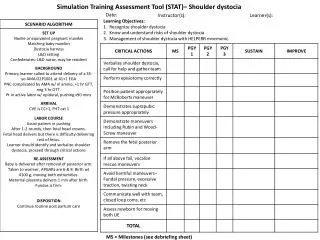
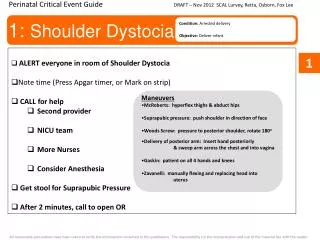
Shoulder dystocia mnemonic • H E L P E R R • H: Call for plenty of help • E: Episiotomy • L: Legs in McRoberts • P: Pressure (Suprapubic) • E: Enter (Rotational Manoevres) Rubin or Wood’s or reverse Wood’s • R: Remove posterior Arm • R: Roll over onto all fours
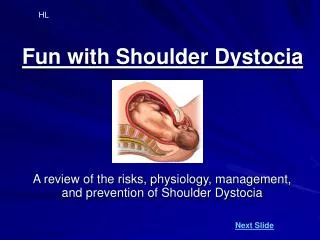
Mechanism • Failure of shoulders to rotate into the transverse diameter of the pelvic inlet • Posterior shoulder enters the pelvis • Anterior shoulder gets stuck behind the symphysis pubis • In more severe cases both shoulders get stuck at the brim
Conclusion • Shoulder dystocia is an acute obstetric emergency • Cannot predict when and in whom this can occur • Risk factors can be identified • Staff need to be ready and aware through regular education and training sessions and drills • Incident Reporting forms (IR form)