Immunization Protects Everyone
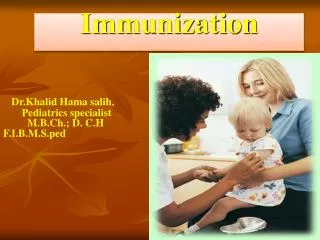
National Immunization Week, held from April 23 to 30, 2011, highlights the critical role of immunization in protecting public health. With a focus on increasing vaccine coverage and reducing vaccine-preventable diseases, various community strategies are emphasized, including client reminders, home-visiting services, and expanded clinic hours. Evaluating these immunization programs is essential for accountability, improving implementation, and informing health policy. This initiative also acknowledges the importance of community ownership and education in achieving vaccination success.

Immunization Protects Everyone
E N D
Presentation Transcript
Immunization Protects Everyone National Immunization Week April 23 to 30, 2011 Immunize.ca
National Immunization Strategy • Reductions in vaccine-preventable diseases • Improved vaccine coverage rates • Objective measurement of progress program evaluation
“The very success of immunization programs has proven to be one of their weaknesses”
Evidence Sufficient to Strongly Recommend • Client reminder/recall systems • Requirement for enrollment • Expanding clinic hours • Using emergency departments • Offering drop-in vaccination services • Home-visiting services • Use of electronic records • Vaccination settings closer to clients’ home • Immunizers are fully immunized
Insufficient Evidence to Recommend • Community education • Patient incentives • Patient-held records • Provider education • Using standing orders
Adolescents • Concrete thinkers (ages 9-12) • Abstract thinkers (ages 14-16) • Adult….(ages 16-19)
Community OwnedImmunization program “The program helped me get my child immunized because she kept getting on me about keeping my appointments”
Why evaluate? • Determine achievement of objectives • Improve program implementation • Accountability • Community support for initiatives • Contribute to scientific base for interventions • Inform policy decisions
References • Advisory Committee on Population Health and Health Security. 2003. National Immunization Strategy. • Boom, J., Nelson, C., Kohrt, A., & Kozinetz, C. 2010. Utilizing peer academic detailing to improve childhood immunization coverage levels. Health Promotion Practice. 11(3) 377-386. • Capwell, E., Butterfoss, F., & Francisco, V. 2000. Why evaluate? Health Promotion Practice. 1(1), 15-20. • Findley, S., Irigoyen, M., Sanchez, M., Guzman, L., Mejia, M., Sajous, M., Levine, D., Chen, S., & Chimkin, F. 2006. Community-based strategies to reduce childhood immunization disparities. Health Promotion Practice. 7(3), 191-200. • Findley, S., Irigoyen, M., Sanchez, M., Guzman, L., Mejia, M., Sajous, M., Levine, D., Chen, S., & Chimkin, F. 2009. REACH 2010: New York City. Health Promotion Practice. 10(2), 128-137. • IWK Grace Health Center. 2011. Increasing Immunization Coverage. Pediatrics. 125, 1295-1304. • Kaplan, D. (2009). Barriers and potential solutions to increasing immunization rates in adolescents. Journal of Adolescent Health.46, 24-33. • Saville, A., Albright, K., Nowels, C., Barnard, J., Daley. M., Stokley, S., Irby, K., & Kempe, A. 2011. Getting under the hood: Exploring issues that affect provider-based recall using an immunization information system. 11(1), 44-49.