Analysing Microarray Data Using Bayesian Network Learning
This study investigates the effectiveness of Bayesian Networks in analyzing microarray data for classification. The research explores the challenges inherent in microarray data, including large variable counts, noise, and data standardization. A program was developed in MATLAB using Bayes Net Toolbox to assess classification accuracy against real and synthetic datasets. The results indicate the potential of Bayesian methods for handling complex gene expression data, alongside comparisons with other classification techniques. Future work includes enhanced structure learning and classification improvements.

Analysing Microarray Data Using Bayesian Network Learning
E N D
Presentation Transcript
Analysing Microarray Data Using Bayesian Network Learning Name: Phirun Son Supervisor: Dr. Lin Liu
Contents • Aims • Microarrays • Bayesian Networks • Classification • Methodology • Results
Aims and Goals • Investigate suitability of Bayesian Networks for analysis of Microarray data • Apply Bayesian learning on Microarray data for classification • Comparison with other classification techniques
Microarrays • Array of microscopic dots representing gene expression levels • Gene expression is the process of DNA genes being transcribed into RNA • Short sections of genes attached to a surface such as glass or silicon • Treated with dyes to obtain expression level
Challenges of Microarray Data • Very large number of variables, low number of samples • Data is noisy and incomplete • Standardisation of data format • MGED – MIAME, MAGE-ML, MAGE-TAB • ArrayExpress, GEO, CIBEX
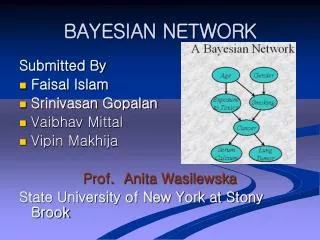
Bayesian Networks • Represents conditional independencies of random variables • Two components: • Directed Acyclic Graph (DAG) • Probability Table
Methodology • Create a program to test accuracy of classification • Written in MATLAB using Bayes Net Toolbox (Murphy, 2001), and Structure Learning Package (Leray, 2004) • Uses Naive network structure, K2 structure learning, and pre-determined structure • Test program on synthetic data • Test program using real data • Comparison of Bayes Net and Decision Tree
Synthetic Data • Data created from well-known Bayesian Network examples • Asia network, car network, and alarm network • Samples generated from each network • Tested with naive, pre-known structure, and with structure learning
Synthetic Data - Results 50 Samples, 10 Folds, 100 Iterations Class Node: Dyspnoea 100 Samples, 10 Folds, 50 Iterations Class Node: Dyspnoea Asia Network Lauritzen and Spiegelhalter, ‘Local Computations with Probabilities on Graphical Structures and Their Application to Expert Systems’, 1988, pg 164
Synthetic Data - Results 50 Samples, 10 Folds, 100 Iterations Class Node: Engine Starts 100 Samples, 10 Folds, 50 Iterations Class Node: Engine Starts Car Network Heckerman, et al, ‘Troubleshooting under Uncertainty’, 1994 pg 13
Synthetic Data - Results 50 Samples, 10 Folds, 10 Iterations Class Node: InsufAnesth ALARM Network 37 Nodes, 46 Connections Beinlich et al, ‘The ALARM monitoring system: A case study with two probabilistic inference techniques for belief networks’, 1989 50 Samples, 10 Folds, 10 Iterations Class Node: Hypovolemia
Lung Cancer Data Set • Publically available data sets: • Harvard: Bhattacharjee et al, ‘Classification of Human Lung Carcinomas by mRNA Expression Profiling Reveals Distinct Adenocarcinoma Subclasses’, 2001 • 11,657 attributes, 156 instances, Affymetrix • Michigan: Beer et al, ‘Gene-Expression Profiles Predict Survival of Patients with Lung Adenocarcinoma’, 2002 • 6,357 attributes, 96 instances, Affymetrix • Stanford: Garber et al, ‘Diversity of Gene Expression in Adenocarcinoma of the Lung’, 2001 • 11,985 attributes, 46 instances, cDNA • Contains missing values
Feature Selection • Li (2009) provides a feature-selected set of 90 attributes • Using WEKA feature selection • Also allows comparison with Decision Tree based classification • Discretised data in 3 forms • Undetermined values left unknown • Undetermined values put into either category – two category • Undetermined values put into another category – three category • WEKA: Ian H. Witten and Eibe Frank, ‘Data Mining: Practical machine learning tools and techniques’, 2005.
Harvard Set • Harvard Training on Michigan • Harvard Training on Stanford
Michigan Set • Michigan Training on Harvard • Michigan Training on Stanford
Stanford Set • Stanford Training on Harvard • Stanford Training on Michigan
Future Work • Use structure learning for Bayesian Classifiers • Increase of homogeneous data • Other methods of classification