LARP Rotatable Collimator Prototype
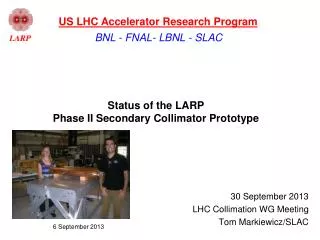
The assembly of the LARP Rotatable Collimator prototype is complete, with all mechanical tests showing successful results. Despite damaged cooling tubes discovered post-welding, both jaws incorporate innovative thermal performance designs. The first jaw features a non-OFE copper conductor, while the second uses OFE copper tubing. Key repairs were made to address weaknesses, ensuring vacuum integrity and effective operation after a thorough bakeout process. Essential improvements and lessons learned will guide the next steps in the prototype's development, targeting delivery to CERN by Summer 2012.

LARP Rotatable Collimator Prototype
E N D
Presentation Transcript
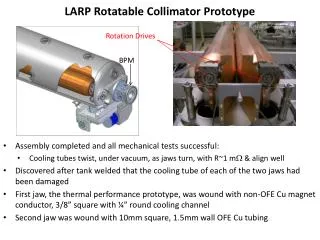
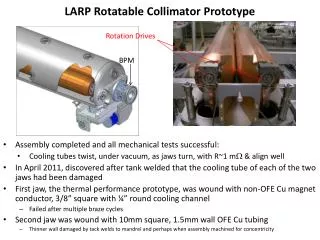
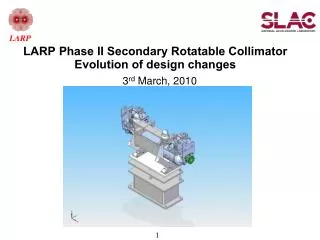
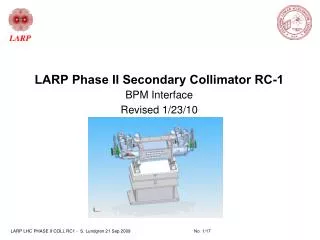
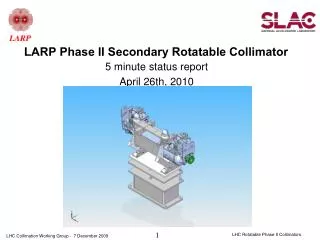
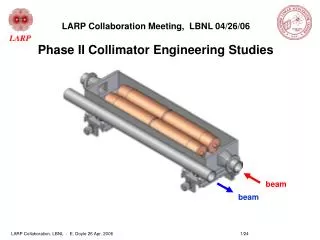
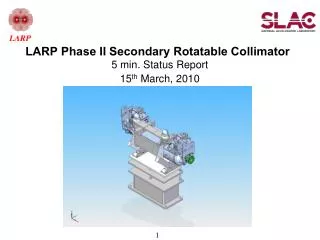
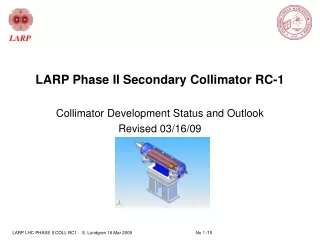
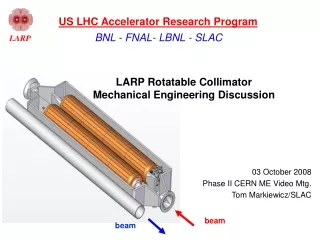
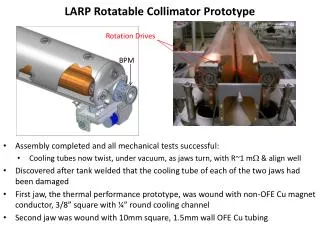
LARP Rotatable Collimator Prototype Rotation Drives BPM • Assembly completed and all mechanical tests successful: • Cooling tubes now twist, under vacuum, as jaws turn, with R~1 m & align well • Discovered after tank welded that the cooling tube of each of the two jaws had been damaged • First jaw, the thermal performance prototype, was wound with non-OFE Cu magnet conductor, 3/8” square with ¼” round cooling channel • Second jaw was wound with 10mm square, 1.5mm wall OFE Cu tubing
Crack in Copper Magnet Conductor Used for Winding First Prototype Jaw Suspect weakening in non-OFE Cu tubing at crystal grain boundaries after last of many high temperature firings Repaired with solder patch Accelerator Systems - T. Markiewicz
Leaks at Tack Welds and Perhaps at Thinned Points in Thinner Walled Tubing Used for Winding 2nd Prototype Jaw Tube walls thinned to 0.030” in places when mandrel prepped for jaw braze Repaired with “CuSil” “SNOOP” bubbles at tack welds used to secure tubing: 5 leak points Neither of these procedures are fundamental; assembly process will avoid these two procedures
Other Lessons Learned During Prototype Testing and Next Steps • After 5 weeks of bakeout tank & jaws (tubes sealed) reach P=4.4E-9 torr with clean RGA & rotation mechanism works after bakeout • “Less important” mechanical issues that need attention • Replace problematic free floating RF bearings with race-constrained bearing • Capture main bearing so cannot slide off during bakeout • Replace W-S2 coated main bearing with ceramic bearing • 1 of 4 main bearings froze to race during bakeout • Non-fundamental issues that will not be changed • Impedance dominated by tank size & simplified RF transitions • Recent desire for BPMs that move with jaws will not be implemented • Plan is to replace both jaws & reinsert into existing base plate with existing vacuum bellows and motion system for beam and then destructive testing in HiRadMat facility • Delivery to CERN Summer 2012 • Activity supported by SLAC and carry-forward funds