
Engaging Elderly Citizens in Mobility Issues: Insights from the MESsAGE Research Project
E N D
Presentation Transcript
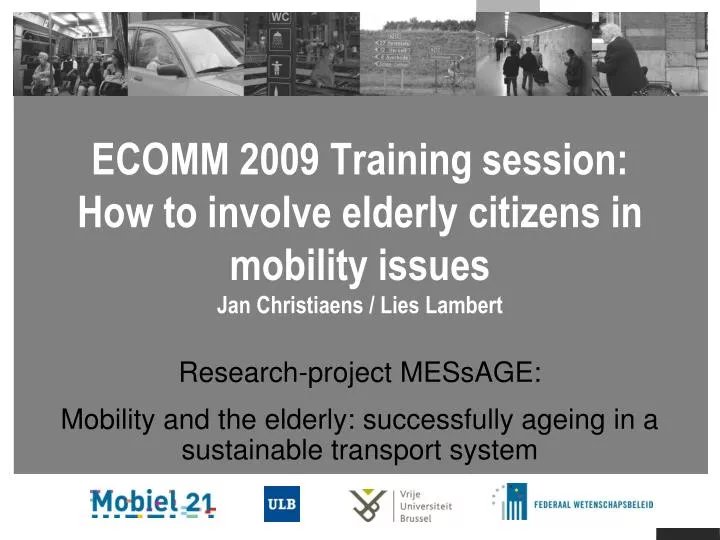
ECOMM 2009 Training session:How to involve elderly citizens in mobility issues Jan Christiaens / Lies Lambert Research-project MESsAGE: Mobility and the elderly: successfully ageing in a sustainable transport system
Agenda • Introduction to MESsAGE • Engage ! Engaging in an action research on mobility situation of conference centre through role playing game • Analysis of black points (round table) • Development of the action (round table) • Presentation of the action (plenary) • Closing remarks
Introduction to MESsAGE • research project • funded by the Federal Research Programme for sustainable development • partners: VUB, ULB, Mobiel 21 • OBJECTIVES • the extension of the transportation autonomy of older people • increase the use of sustainable transport modes within this target group
Introduction to MESsAGE WP1: literaturereview WP2: Quantitative research Analysis surveys on travel behaviour & on needsamong elderly people VUB WP4:Action research Pilot participatory methods with elderly M21 WP3:Qualitative researchObservations, interviews & collective discussions with elderlyULB WP5: Integration of research conclusions and policyrecommendations
Research questions? • How often, where to, how and when are elderly citizens mobile? • Are there hindering factors? (individual, social, financial) • How important is mobility for them? • Are there any needs, problems, concerns or wishes? • Can we find solutions? • Does local mobility policy take into account these needs and problems? • How can elderly people influence policy?
Overview 1. Elderly ≠ minority in traffic 1999 = 1/6 Belgians ≥ 65 j. 2010 = 1/4 Belgians ≥ 60 j. 2050 = 1/3 Belgians ≥ 60 j. THEREFORE… It’s important to know their mobility pattern, needs, problems and concerns
Overview 2. Elderly people are less mobile (lesser trips outdoors, lesser long-distance trips, other motives, other times) BUT… Next generation = better educated increased level of welfare higher life expectancy healthier for a longer period → Higher degree of mobilty and “Ageing in place”
Overview 3. Cars on pole position car = central role in transportautonomy BECAUSE… • Best answer to diffuse and complexe mobility needs ( ≠ commuter travel) • Feeling of guaranteed security (highest perception of safety) • Most accessible (+ guarantee on accessibility of destinations)
Overview 4. Elderly pedestrians & cyclists are vulnerable • Involved in an accident → 25% more fatalities and casualties than average • Cyclists over 75 y. → risk of having an accident becomes very high THEREFORE… Risk-avoiding behaviour (cfr. Clever driving management) = avoid driving after dark, in bad weather conditions or in rush hour, detours to avoid bad footpaths, …
Overview 5. Elderly people = walkers Walking = specific transport mode (everybody walks, often in relation with other modes, … BUT… • Feelings of insecurity • Conflicts • Physical limitations
Overview 6. Needs, concerns, wishes? • More courtesy among road users, bus drivers, .. • Design of public space • Infrastructure at busstops, points of rest, footpaths, … • Traffic management • Traffic lights, pedestrian crossings • Tailored information & education
Action-research? Specific research methodology which conducts research: “… which involves all relevant parties in actively examining together current action in order to change and improve it.” Wadsworth, Y. (1998)
Participative Action Research • Action research • Five sites (Sint-Truiden, Leuven, Brussel, Gembloux, Mons) • Same cyclical process (needs analysis, planning, implementation and evaluation) • Common monitoring and evaluation framework (survey and group evaluation) • General • Variety of backgrounds, group compositions and group dynamics • Duration: between 7 months and one year (5-10 meetings)
Results of action research • Needs Analysis
Results of action research • Actions
Main findings (1) • Needs analysis • Information on public transport • Lack of tailored and targeted information • Complexity of the public transport system • Problematic accessibility of the pt system • Referral to infrastructure • Sidewalks and cycle lanes • Roundabouts and crossing • Lighting • Lack of courtesy and respect
Main findings (2) • Action • External coaching is needed • Support of local authorities or senior organisations • Good welcome (location, atmosphere) • Clear step-by-step plan • Talking phase is very important • Clear division of tasks • Continuous process • Evaluation and follow-up • Conclusion • Mobility matters! • Elderly are willing to participate and to give their opinion. • Elderly can act themselves and stand up for themselves • Elderly want to be listened to and believed in by authorities.
Results of action research • Why use action research in your community • Innovative approach on participation (from complaints to co-production of policy measures) • Improve involvement of elderly citizens in your local policy • Hands-on, pragmatic methodology • In-depth analysis • Input for local policy • Competence building of elderly citizens and local policymakers
Engage ! PART 1: analysis of black points • Check your identity-card • Try to discuss as much problems as possible • Accessibility • Quality of environment • Safety • Write them down • Try to prioritise
Engage ! PART 2: Development of the action • Choose one action-theme • Discuss action • Method • Target • Target group • Division of tasks • Stakeholders • Try to be as ‘real’ as possible
Engage ! PART 3: presentation of the action • Present your action • Process • Why is your action likely to have serious impact?
Closing remarks • What do you take home? • What would you suggest to improve?
Thank you for your attention and cooperation ! www.mobiel21.be Jan Christiaens Lies Lambert jan.christiaens@mobiel21.belies.lambert@mobiel21.be