Download
1 / 27
270 likes | 399 Vues
The First World War, beginning in 1914, was a devastating conflict that redefined warfare. Initially, many believed the war would be short, with soldiers returning home by Christmas. However, the Schlieffen Plan failed, leading to a prolonged conflict. Trench warfare emerged, drastically changing battle tactics. Soldiers faced horrific conditions, living alongside dead and vermin in muddy trenches while enduring relentless shelling. The intense battles resulted in significant casualties and minimal territorial gains, showcasing the brutal realities of war.

E N D
The First World War c) The unfolding of the war
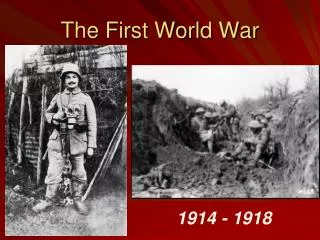
d) The unfolding of the war • When war broke out in _____________, _______________________________________ • Many even believed that the soldiers would return to celebrate Christmas with their families Germansoldiers in 1914
d) The unfolding of the war • Fighters regrouped into two camps: the ___________and_____________.
d) The unfolding of the war The Germans' Schlieffen Plan: Military Plan twofold: • ________________________________________ (or so they thought!) • A major military campaign against Russian troops • The success of the plan depended on _______________ _____________________________________________
d) The unfolding of the war The Germans' Schlieffen Plan: • In less than _________________, Germany had conquered Belgium, but the Belgian resistance had slowed the attack, which allows the British and the French to stop the Germans a few kilometers from Paris • ____________________________________________________
http://www.youtube.com/watch?v=lJXAcl8D51Y (The failure of the Schlieffen Plan) Reflection: Describe Alfred von Schlieffen’s plan for the invasion of France, and explain why the defeat of France was Germany’s primary objective.
d) The unfolding of the war 2. The _____________________: • September 1914, a great battle between ________________________________ broke out near the Marne River in France
d) The unfolding of the war • The ________________ ____________________ ____________________ ___________________ • The German war plan had ________________ • The German armies had been held back, but not vanquished • It now becomes clear that the war will be far from short ...
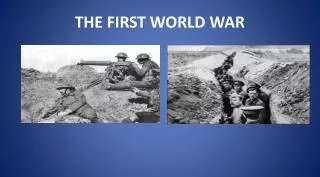
d) The unfolding of the war 3. Trench warfare: • After the Battle of the Marne, how to wage war changed • War "of movement" becomes __________ __________________ • Trench warfare is required
d) The unfolding of the war 3. Trench warfare: The evolution of war: http://www.youtube.com/watch?v=vZFRcuP3R4E
d) The unfolding of the war • Early trenches were ____________________________________________________________________________________ • But in a short time, two parallel trenches marked the division between the Allies and the Germans over ____________________ • On the Eastern Front, a similar system existed between the ___________________________ ______________________________________
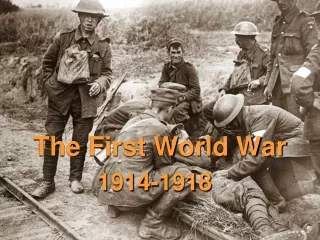
d) The unfolding of the war 4. The lives of soldiers • Trench warfare was ___________________________ • Hundreds of soldiers lived and worked together in a trench • __________________________________________________________________________________________ • Often the trenches were full of rats rummaging in the garbage, the living and the dead • In addition, the enemy was often ________________...
d) The unfolding of the war • The work of the soldiers was especially difficult during the night, that is to say, bring supplies and ammunition and repairing trenches • In small groups, soldiers _________________________ ____________________________________________________________________________________________ • After __________ at the front, the soldiers retreated to take a few days off
d) The unfolding of the war 5. Battles: • The most difficult moments for soldiers were during the great battles • Some soldiers hid in their trenches or shelters dug in the ground, but others were left outside to guard • At the end of bombardment, the soldiers left their shelter and tried to cross through the "no man's land", very few succeeded
d) The unfolding of the war • During battles in the trenches, the soldiers served mainly rifles, bayonets and grenades
d) The unfolding of the war • The results for most of the battles was similar: a lot of dead and wounded and short gains on the ground