Download
1 / 10
100 likes | 210 Vues
This report investigates the sexual and reproductive health (SRH) needs of adolescents in emergency settings, specifically in Haiti following the 2010 earthquake and in Pakistan during recent disasters. It utilizes methodologies such as the Minimum Initial Service Package (MISP) and qualitative interviews with local and international organizations. Key findings emphasize the exacerbation of gender-based violence, maternal health, and the lack of male involvement in both contexts. Recommendations highlight the need for tailored responses, disaster preparedness, and inclusive approaches to build resilient health systems.

E N D
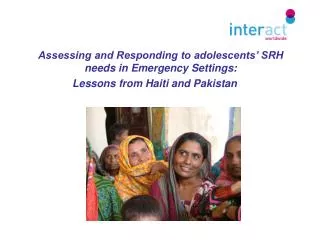
Assessing and Responding to adolescents’ SRH needs in Emergency Settings: Lessons from Haiti and Pakistan
Introduction • Interact Worldwide: • SRHR organisation focusing on marginalised groups including adolescents • Plan International – UK: • child-focused organisation with a particular growing focus on adolescent girls
Methodology • MISP • Adolescent SRH in humanitarian settings toolkit 2010 (UNFPA/Save US) • FGDs • Key informant interviews: • Local NGOs • International NGOs and UN Agencies • MoH • Cluster / Sub-cluster meetings
HAITI Immediate onset earthquake resulting in large-scale destruction within a large but defined geographical space involving a generally homogeneous population and resulting in: 220,000 instant deaths 300,000 injured 2.3 million affected / displaced. PAKISTAN Slow yet rapidly increasing gradual disaster affecting a massive geographical area including regions with vastly different traditional cultural practices and ultimately resulting in: Less than 2,000 deaths Nearly 2 mill homes destroyed Over 20 mill people affected / displaced Differences due to nature of emergency within existing country context:
Key Findings / Recommendations - HAITI • GBV – rape, “a response to a girl” • GBV – broader sexual exploitation • MNH – particularly adolescent MNH • Male involvement - lacking
Key Findings / Recommendations - PAKISTAN • Adolescent SRH in general doesn’t exist • GBV – Child Marriage • MNH – particularly adolescent SRH • FP – increased • Male involvement - lacking
Similarities • In general any existing social problem affecting most vulnerable populations (including women and children) will be exacerbated by an emergency – • In Haiti, GBV - rape • In Pakistan, GBV – child marriage • Some unintended positive outcomes • Increase in MNH services in both Haiti and Pakistan • Increase in access to FP information in Pakistan • Male engagement lacking in both situations
Programme Conclusions • ASRH response in emergencies is more dependant on existing cultural and religious context than other sector responses: need for strong disaster preparedness in this area as cannot apply a “one-size fits all” • Always the potential for “re-building better”
Policy Recommendations • Prepare now…..in order to…. • Respond immediately and appropriately • Rebuild ambitiously