Download
1 / 3
30 likes | 159 Vues
This presentation dives into the estimation of DEB (Dynamic Energy Budget) parameters using a standard model incorporating reserve and structural components. Aimed at PhD students, it discusses the use of measured quantities and hidden variables across different food levels, showcasing applications to bivalves. Participants are encouraged to engage in local meetings and utilize DEBtool for practical insights, with slides available online. This session aims to foster collaborative learning within the DEB community, enhancing understanding of these ecological models.

E N D
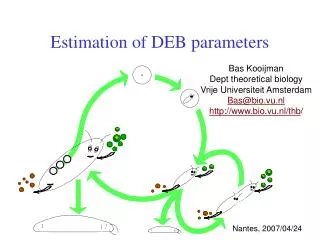
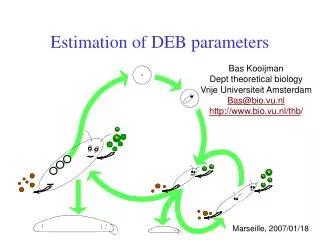
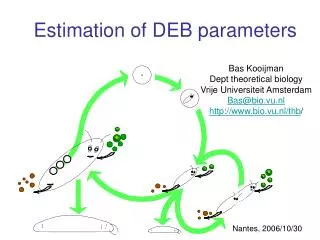
Estimation of DEB parameters Bas Kooijman Dept theoretical biology Vrije Universiteit Amsterdam Bas@bio.vu.nl http://www.bio.vu.nl/thb/ Nantes, 2006/10/30
measured quantities primary pars Standard DEB model (isomorph, 1 reserve, 1 structure) reserve & maturity: hidden variables measured for 2 food levels primaryparameters
DEB tele course 2007 Cambridge Univ Press 2000 http://www.bio.vu.nl/thb/deb/ Free of financial costs; some 250 h effort investment Feb-April 2007; target audience: PhD students We encourage participation in groups that organize local meetings weekly French group of participants of the DEB tele course 2005: special issue of J. Sea Res. 2006 on DEB applications to bivalves Software package DEBtool for Octave/ Matlab freely downloadable Slides of this presentation are downloadable from http://www.bio.vu.nl/thb/users/bas/lectures/ Audience: thank you for your attention Sebastian Diehl: thank you for the invitation